
American Mahjong vs Japanese Mahjong: A Side-by-Side Guide
American Mahjong (NMJL) and Japanese Riichi Mahjong share the same ancestors but play like different sports. Here is every major difference, from tile count to scoring, so you can talk shop with any player at your table.
By Trey Peirce
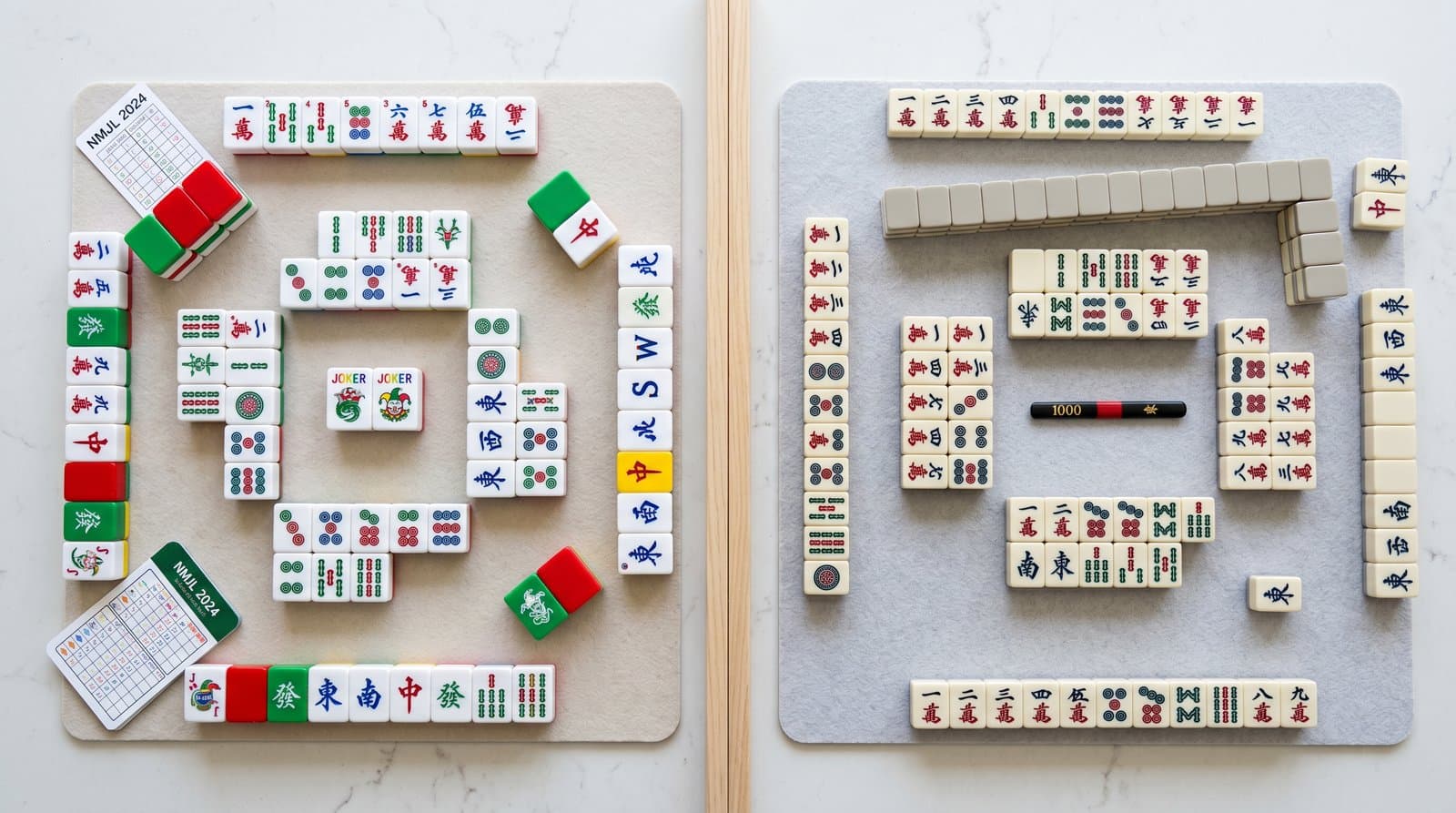
TL;DR. American Mahjong (NMJL) uses 152 tiles including eight jokers, scores hands against a printed card that changes every April, and starts each round with the Charleston, a ritual passing of tiles. Japanese Riichi Mahjong uses 136 tiles with no jokers, scores through a mathematical system of yaku (winning patterns) and han (point multipliers), and features the signature riichi declaration, a 1,000-point bet that you are one tile from winning. Both games descended from the same Chinese roots, but they diverged so sharply over the last century that mastering one gives you almost no head start on the other.
Two Games, One Set of Ancestors
American Mahjong and Japanese Riichi Mahjong both trace their lineage to 19th-century China. That is roughly where the similarities end. The American version arrived in the 1920s, took root in Jewish American social circles, and evolved under the governance of the National Mah Jongg League (NMJL), founded in 1937. The Japanese version developed independently across East Asia, formalized its rules in the postwar period, and now operates under organizations like the Japan Professional Mahjong League (JPML) and the European Mahjong Association (EMA).
If you run a club or teach lessons, understanding the differences matters. Your players will ask. Prospective members might come from either tradition. And if you ever consider expanding your programming to include Riichi nights, you will want to know exactly what you are getting into.
Tile Count and Composition
The most visible difference sits right on the table.
American Mahjong (NMJL): 152 tiles total. Three suits (Bams, Craks, Dots) with tiles numbered 1 through 9, four of each (108 suit tiles). Four Winds (East, South, West, North, four of each = 16). Three Dragons (Red, Green, White/Soap, four of each = 12). Eight Flowers (numbered 1-8). Eight Jokers (wild tiles, unique to the American game).
Japanese Riichi Mahjong: 136 tiles. The same three suits and four of each (108 suit tiles). The same four Winds (16) and three Dragons (12). No flowers. No jokers. Some sets include red fives (akadora), replacing one regular five in each suit, which act as bonus scoring tiles.
The eight jokers are the defining physical difference. In American Mahjong, jokers can substitute for any tile in a group of three or more identical tiles, which opens up hand-building strategies that simply do not exist in Riichi. The absence of jokers in Riichi means every tile in your winning hand must be exactly the right tile, no substitutes.
Scoring: A New Card Every Year vs. a Permanent Rulebook
This is the difference that surprises most people.
American Mahjong scores hands against a printed card published by the NMJL every April 1. The card lists roughly 70 valid winning hands organized into categories (2468, Quints, Consecutive Run, Winds/Dragons, Singles and Pairs, and others). Each hand has a point value ranging from 25 to 85 points. If your completed hand does not match one of the patterns on the card exactly, it is not a winning hand, period. The card costs a few dollars and the NMJL sells roughly 350,000 of them each year to its membership base.
Japanese Riichi Mahjong uses a permanent scoring system built on two variables: yaku (winning conditions) and han (point multipliers). There are 37 standard yaku, each worth a specific number of han. The base score is calculated as fu (minipoints based on hand composition) multiplied by 2 raised to the power of (2 + han). When the total han reaches 5 or more, scoring shifts to fixed tiers: Mangan (8,000 points for a non-dealer), Haneman, Baiman, Sanbaiman, and the elusive Yakuman (32,000 points for a non-dealer). One critical rule: if your hand contains zero yaku, you cannot win, even if the tiles form a valid group structure.
For club operators, the practical implication is significant. American Mahjong players need to buy a new card every year and spend the first few weeks of April learning the new hands. That annual reset creates a natural recruiting window and a reason to run "New Card" workshops. Riichi players, by contrast, learn the scoring system once and refine their understanding over years.
Gameplay Mechanics
The Charleston (American Only)
Before a single tile is drawn from the wall, American Mahjong players perform the Charleston: a structured exchange of tiles with other players. The basic Charleston has three passes (right, across, left), each involving three tiles. After that, an optional second Charleston can proceed if all four players agree. A final "courtesy pass" of one, two, or three tiles with the player across the table closes the ritual. Jokers cannot be passed during the Charleston.
The Charleston is social infrastructure disguised as game mechanics. It forces interaction before the competitive phase begins, sets the rhythm of the table, and gives operators a natural icebreaker moment for new players.
Riichi Declaration (Japanese Only)
When a Riichi player is one tile away from completing a winning hand (tenpai) and their hand is fully concealed (no open melds), they can declare "riichi" by placing a 1,000-point stick on the table. This bet locks their hand: they cannot change their tile composition. In exchange, they gain access to bonus scoring tiles (ura-dora) if they win, potentially doubling or tripling their payout.
The riichi declaration creates a moment of high drama. The entire table knows someone is close to winning. Defensive play intensifies. It is the signature mechanic of the Japanese game and the source of its reputation for strategic depth.
Calling and Melding Differences
Both games allow players to claim discarded tiles, but the rules differ:
| Action | American (NMJL) | Japanese (Riichi) |
|---|---|---|
| Claiming for a set of 3 | Allowed (call) | Chi (sequence, left player only), Pon (triplet, any player) |
| Claiming for a pair | Only for the winning tile | Only for the winning tile (ron) |
| Exposing tiles | Called sets are placed face-up | Open melds reduce hand value (some yaku require concealed hands) |
| Joker exchange | Yes, swap a joker from an exposed set if you hold the tile it represents | N/A |
Furiten (Japanese Only)
Riichi has a rule with no American equivalent: furiten. If your winning tile appears in your own discard pile, you lose the right to win by claiming another player's discard. You can only win by drawing the tile yourself (tsumo). This rule adds a layer of memory and planning that does not exist in American Mahjong.
The Table Setup
American Mahjong players typically use racks and pushers: angled wooden or plastic trays that hold tiles upright and let players push their wall forward in one motion. The standard American setup seats four players at a card table or dedicated mahjong table.
Riichi players in Japan often use automatic shuffling tables (jidou taku) that cost anywhere from $1,000 to $5,000 and handle tile shuffling and wall-building at the push of a button. In the West, most Riichi players still use manual flat tables without racks, standing tiles directly on the table surface.
For studio owners considering both formats, the equipment investment differs. American racks and pushers cost $20 to $60 per set. A quality automatic Riichi table is a serious capital purchase, though it dramatically speeds up gameplay between rounds.
Community and Demographics
The communities around each variant could hardly be more different.
American Mahjong has deep roots in Jewish American women's social circles, dating back to the 1920s. The NMJL's 350,000+ members are overwhelmingly female, with the core demographic skewing toward women aged 50 to 75. Facebook groups like "Mah Jongg, That's It!" (67,000+ members) and "Mahj Life Community" (55,000+ members) serve as the primary online gathering spaces. The game's recent boom has brought younger and more diverse players to the table, but the community's center of gravity remains suburban women's social groups.
Japanese Riichi Mahjong has a younger, more gender-balanced, and more globally distributed player base. Anime like Akagi (2005) and Saki (2006) introduced millions of non-Japanese players to the game. Online platforms like Mahjong Soul (launched 2019 by Yostar, free-to-play) and Tenhou (launched 2007, the competitive standard) sustain active communities of hundreds of thousands of players. The World Riichi Championship, held every three years since 2014, drew 224 players from dozens of countries to its 2017 Las Vegas event. The EMA oversees European competition under a standardized Riichi Competition Rules (RCR) framework adopted in 2008.
Learning Curve
American Mahjong is easier to start but resets annually. A new player can learn the basic mechanics in one session: pick up a tile, discard a tile, try to match a hand on the card. The card itself is the challenge. With roughly 70 valid hands, reading the card fluently takes practice, and every April, everyone starts the interpretation process over.
Riichi Mahjong has a steeper initial learning curve but a more stable knowledge base. Understanding the 37 yaku, the han/fu scoring math, furiten, and defensive strategies like suji and kabe takes months of study. But once learned, the rules do not change year to year. Improvement is continuous rather than cyclical.
For instructors, this difference shapes your curriculum. American Mahjong classes benefit from annual "New Card" workshops and beginner bootcamps timed to the April release. Riichi instruction is better structured as a progressive series, from basic tile recognition through intermediate strategy to advanced defensive play.
Online Play
The online experience reflects each community's character.
American Mahjong has limited online options. A few apps exist, but none have achieved the scale or polish of major Riichi platforms. Most American players treat the game as an in-person social activity, which is one reason club operators have such a captive audience.
Riichi dominates digital mahjong. Mahjong Soul's slick interface and gacha-style cosmetics appeal to a younger demographic, while Tenhou's austere, data-rich environment attracts serious competitive players (subscription for top-tier rooms runs about 550 yen per 25 days). These platforms generate a pipeline of players who may eventually seek in-person play, creating an opportunity for clubs that offer Riichi programming.
Tournament Scenes
American Mahjong tournaments are typically organized by local clubs, JCCs, and community centers. The NMJL sanctions some events. Entry fees range from $25 to $100, formats vary, and the social component is as important as the competitive one.
Riichi has a more formalized tournament infrastructure. National organizations in Japan, Europe, and North America host rated events. The World Riichi Championship and the European Mahjong Championship follow standardized rulesets. Online qualifiers on Mahjong Soul have opened the competitive pipeline further.
Which Variant Is Right for Your Club?
If your members are primarily American Mahjong players (and statistically, they probably are), your programming should center on NMJL. The annual card cycle gives you a built-in content calendar. The social DNA of the game aligns perfectly with club and studio environments. And the relative lack of online alternatives means your physical space is the primary venue for play.
If you are seeing interest from younger players, players who discovered mahjong through anime or online platforms, or players who want a more competitive format, Riichi programming could be a valuable addition. It will not replace your American Mahjong core, but it can expand your reach and fill different time slots.
The most ambitious operators might consider offering both. A few clubs across the country already do, running American Mahjong during weekday afternoons and Riichi nights on weekday evenings or weekends. The key is recognizing that these are genuinely different games with different audiences, different equipment needs, and different teaching requirements.
Frequently Asked Questions
Can I use the same tile set for both games? Not easily. American sets have 152 tiles (including jokers and flowers); Riichi sets have 136. Some sets are sold as "universal" with extra tiles that can be added or removed, but most players prefer a set designed for their specific variant.
Is one variant harder than the other? Riichi has a steeper initial learning curve due to the scoring system and defensive concepts like furiten. American Mahjong is easier to pick up but resets every April with a new card. Long-term mastery is demanding in both.
Are the tiles the same size? Not always. American tiles tend to be larger, designed to fit into racks. Riichi tiles are often smaller and played flat on the table. Tile dimensions vary by manufacturer in both traditions.
Can a Riichi player easily switch to American, or vice versa? The basic concepts (suits, melds, drawing and discarding) transfer, but the strategic thinking does not. Switching variants is closer to learning a new game than adapting an old one.
Running a club means fielding questions from every kind of player. If managing those conversations, along with subs, dues, and scheduling, is eating your evenings, book a 30-minute demo with Mahjician and see how a purpose-built platform handles the operational side so you can focus on the tiles.