Mahjong Tiles Explained: Every Suit, Honor, and Flower
A standard American Mahjong set uses 152 tiles across three suits, four Winds, three Dragons, eight Flowers, and eight Jokers. Here is every tile you need to know, why the set in your box has extra blanks, and how to tell them all apart.
By Trey Peirce
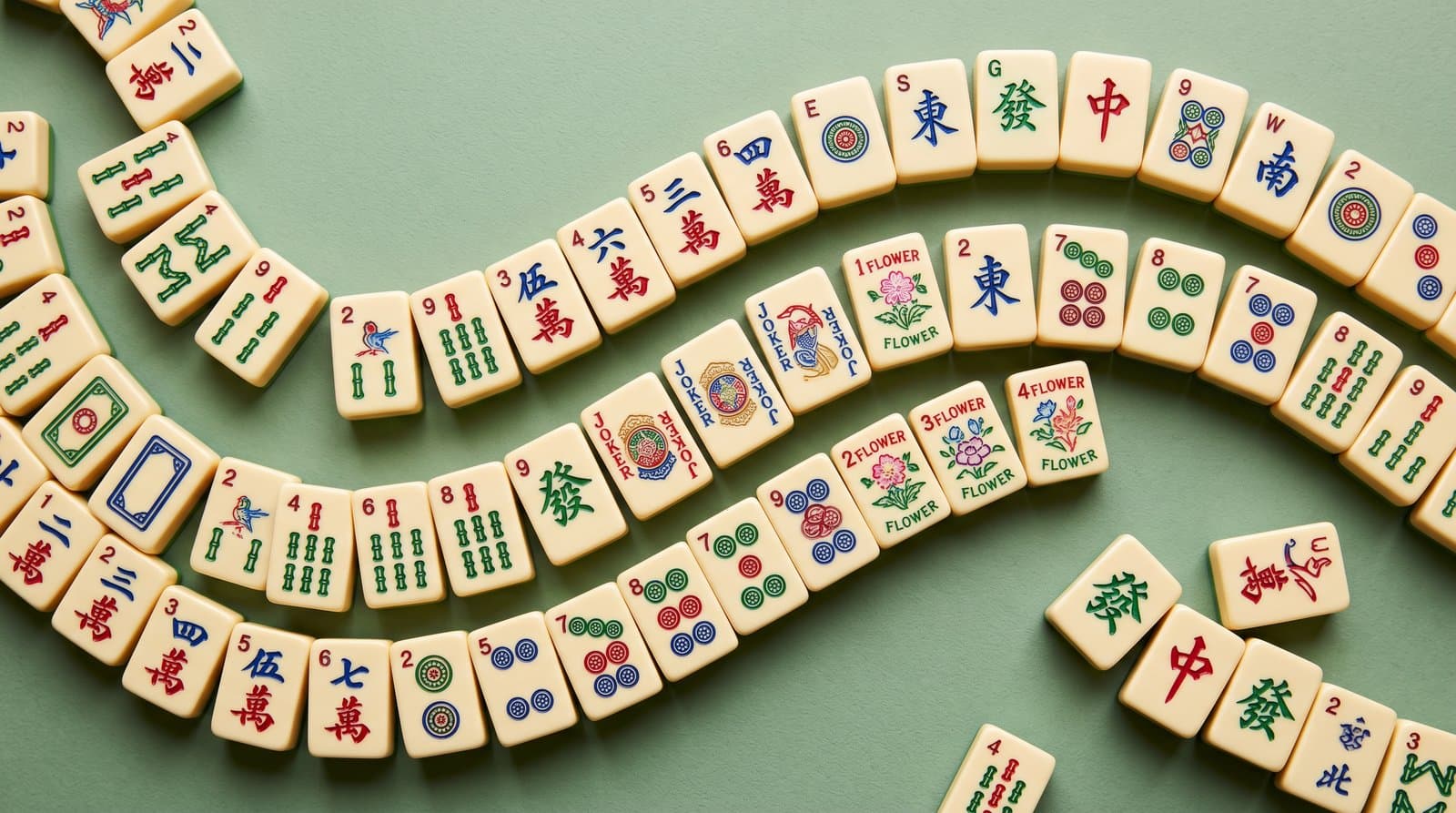
TL;DR. A standard American Mahjong (NMJL) set uses 152 tiles: 108 suited tiles across three suits (Bams, Craks, Dots), 16 Winds, 12 Dragons, 8 Flowers, and 8 Jokers. Jokers and the specific Flower count are unique to the American game. If you just pulled 160 tiles out of a box and got confused, you are not alone: manufacturers include blanks as replacements, and only 152 go on the table.
You cracked open a new set, dumped the tiles on the table, and now you are staring at 160-ish pieces wondering which ones actually belong in the game. Fair. Most American Mahjong sets ship with spare blanks and sometimes extra Jokers, so the count never matches what you expected. The number you need is 152. That is the official tile count for National Mah Jongg League (NMJL) play. Everything beyond 152 is a replacement tile, and it stays in the box.
Below is every tile in an American Mahjong set, organized in the order that makes them easiest to learn: Dots first (they look exactly like what they are), then Bams (once you get past the bird), then Craks (the suit that trips up newcomers). After the suits, we will cover Winds, Dragons, Flowers, and the Jokers that make American Mahjong its own game.
The Three Suits: 108 Tiles
Each suit contains tiles numbered 1 through 9, and every number appears four times. That gives each suit 36 tiles and the three suits a combined 108.
Dots (Circles)
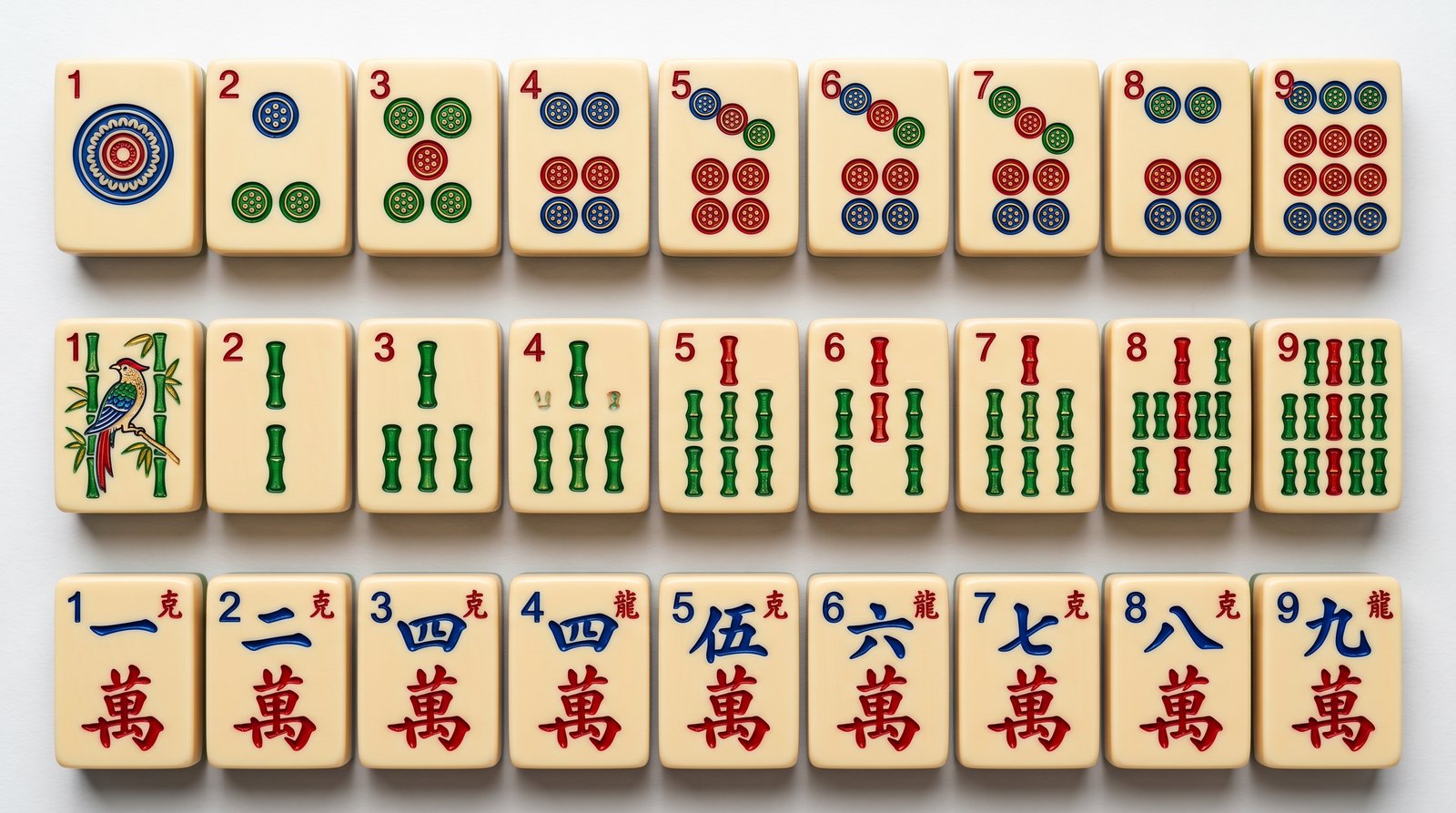
Dots are the friendliest suit for beginners. Each tile displays the exact number of circles you would expect: one circle for 1 Dot, two circles for 2 Dot, and so on up to nine. No hidden symbolism, no artistic flourishes that obscure the count. If you can count circles, you can read Dots.
Historically, the circles on Dot tiles are thought to represent coins, specifically the round copper coins with square center holes used in imperial China. The Smithsonian Magazine notes that mahjong's roots intertwine with Chinese money-card games, and the Dot suit carries that lineage most visibly.
In NMJL notation, you will see Dots written as "1D" through "9D." The White Dragon (Soap) is associated with this suit, a pairing that matters when you read certain hands on the yearly card.
Bams (Bamboos)
Bams are where new players hit their first speed bump, because the 1 Bam does not look like one bamboo stick. It is a bird.
The bird on the 1 Bam is one of the oldest artistic traditions in mahjong. One popular origin story, documented by historians, traces the image to sparrow hunting near the granaries of Taicang in Jiangsu province. Bamboo tallies tracked kills, and the single-stick tile eventually became the sparrow itself. Another theory ties the image to a classical Chinese artistic pairing of sparrows with bamboo. Either way, the convention stuck, and tile makers have been carving birds into the 1 Bam for well over a century.
Tiles 2 through 9 show the corresponding number of bamboo sticks, usually in green and red. The Green Dragon is the honor tile associated with Bams.
In NMJL shorthand, Bams run from "1B" through "9B."
Craks (Characters)
Craks can feel intimidating if you do not read Chinese characters, but you do not need to. Every Crak tile displays an Arabic numeral (1 through 9) somewhere on its face, typically at the top or bottom. The Chinese character below it is the formal number, and the character that appears on every tile in the suit is "wan," meaning ten thousand.
Once you spot the Arabic numeral, ignore the rest. You will memorize the characters naturally over time, but they are not required for play.
Craks pair with the Red Dragon. In NMJL notation, they run "1C" through "9C."
Honor Tiles: Winds and Dragons (28 Tiles)
Honor tiles do not belong to any suit and carry no number. They split into two groups: Winds and Dragons.
Winds (16 Tiles)
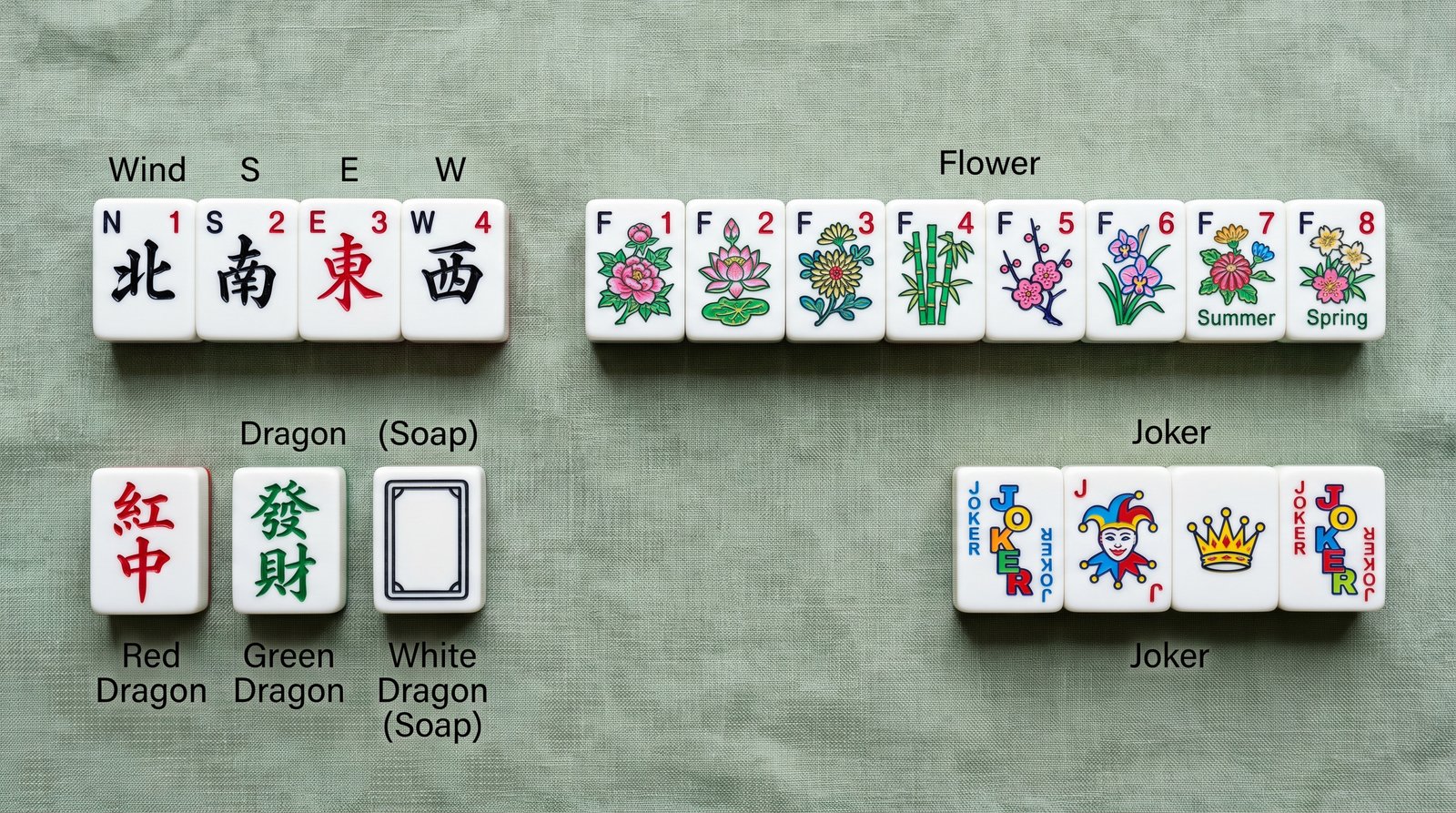
There are four Wind tiles: North, East, South, and West. Each appears four times in the set, giving you 16 total.
Wind tiles display the compass direction in English on most American sets, sometimes alongside the Chinese character. On the NMJL card, Winds often appear in specific groupings. You will see them abbreviated as "N," "E," "S," and "W."
A quick memory trick: if you read the Winds clockwise starting from East on a mahjong table, they run East, South, West, North. That is the opposite of a Western compass. The difference goes back to Chinese cartographic tradition, where south sits at the top of the map.
Dragons (12 Tiles)
Three types of Dragon, four copies each, for 12 tiles total. Each Dragon corresponds to one of the three suits:
- Red Dragon (Craks): Usually shows the Chinese character "zhong" (center/middle) in red. Some sets simply display a red "C" or a red rectangle.
- Green Dragon (Bams): Displays "fa" (prosperity/fortune) in green, or a green "F" on Western-style sets.
- White Dragon, a.k.a. "Soap" (Dots): This is the tile that confuses everyone.
The Soap earned its nickname because early American sets left the White Dragon completely blank, and players thought it looked like a bar of white soap. The name stuck. Modern sets usually add a blue or black rectangular border so you can distinguish a Soap from the spare blank tiles rattling around in your box. If you see a tile with a subtle "B" or "P" stamped on it, that is also a Soap: the letter comes from "bai" (white) in Chinese.
The Dragon-suit pairings (Red with Craks, Green with Bams, Soap with Dots) are not just trivia. Many hands on the NMJL card group a Dragon with its matched suit, so learning these connections pays off quickly.
Flowers (8 Tiles)
American Mahjong sets include eight Flower tiles. Their designs vary wildly from set to set: you might see orchids, chrysanthemums, seasons, or abstract patterns. The specific artwork does not matter for gameplay. All eight Flowers are interchangeable, and on the NMJL card they are simply noted as "F."
Flowers are powerful because they appear in many winning hands, and you only need to collect the right quantity. No matching required.
One thing to note: in Chinese and other regional mahjong variants, Flower tiles have distinct identities and scoring implications. In the NMJL game, that complexity disappears. A Flower is a Flower.
Jokers (8 Tiles)
Here is where American Mahjong breaks from every other major variant. Your set includes eight Joker tiles, and they are wildcards with specific restrictions.
A Joker can substitute for any tile in a group of three or more: pungs (three of a kind), kongs (four of a kind), quints (five of a kind, unique to American Mahjong), and sextets (six of a kind). However, a Joker cannot be used in a pair. That single rule catches more new players than almost anything else.
Additional Joker rules under NMJL play:
- Jokers may not be passed during the Charleston, the pre-game tile exchange unique to American Mahjong.
- A discarded Joker is a dead tile. No one can claim it.
- You can swap a Joker out of another player's exposed group if you hold the tile it represents. This is called "redeeming" a Joker, and it is one of the most strategic moves in the game.
For a deeper look at Joker strategy, check out What Are Jokers in Mahjong?.
The 160-in-the-Box vs. 152-in-Play Problem
Almost every American Mahjong set ships with more than 152 tiles. A typical count out of the box is 160 to 166. The extras are blank replacement tiles (and sometimes two additional Jokers, bringing the box total to 10).
Before your first game, sort out exactly 152 tiles using this checklist:
| Category | Tiles | Count |
|---|---|---|
| Dots (1D through 9D, four each) | 9 x 4 | 36 |
| Bams (1B through 9B, four each) | 9 x 4 | 36 |
| Craks (1C through 9C, four each) | 9 x 4 | 36 |
| Winds (N, E, S, W, four each) | 4 x 4 | 16 |
| Dragons (Red, Green, Soap, four each) | 3 x 4 | 12 |
| Flowers | 8 | |
| Jokers | 8 | |
| Total | 152 |
Set the leftover blanks aside. They are spares in case you lose or damage a tile. If that happens, use a permanent marker to turn a blank into whatever you need.
Tile Identification Decision Tree
This quick reference is for teachers and new players. If you are staring at a tile and cannot figure out what it is, start here:
- Does it say "Joker" or show a "J"? It is a Joker.
- Is it decorated with a unique floral or seasonal image (and possibly numbered 1 through 8)? It is a Flower.
- Does it show a compass direction (N, E, S, W) or the Chinese character for a cardinal direction? It is a Wind.
- Is it red with "zhong" or a "C"? Red Dragon.
- Is it green with "fa" or an "F"? Green Dragon.
- Is it blank with a border, or shows "B" or "P"? White Dragon (Soap).
- Does it show circles? Count them. That is your Dot tile (1D through 9D).
- Does it show bamboo sticks (or a bird for the number 1)? Count the sticks. That is your Bam tile (1B through 9B).
- Does it show a Chinese character with an Arabic numeral? Read the numeral. That is your Crak tile (1C through 9C).
- Is it completely blank with no border or marking? It is a spare. Put it back in the box.
Print this list, laminate it, and keep it at the table. Your students will thank you.
How American Tiles Differ from Other Styles
If you have played Japanese Riichi Mahjong or other variants, the American tile set will look familiar but not identical.
Jokers do not exist in Chinese Classical, Japanese Riichi, or Hong Kong Old Style mahjong. They are exclusive to the American (NMJL) game and a handful of regional variants.
Flower count varies. Chinese and Japanese sets typically include four Flowers and four Seasons (eight total bonus tiles), but they score differently than in American play. The NMJL game treats all eight Flowers as identical and interchangeable.
Tile aesthetics differ. American sets tend to use brighter colors, English lettering, and Arabic numerals alongside the traditional Chinese characters. This makes them more accessible to English-speaking players but means you cannot always use an American set for Chinese Classical play (and vice versa) without some adaptation.
Caring for Your Tiles
Good tiles are meant to last decades. A few habits keep them in shape:
- Clean with a damp cloth, not submerged water. Bakelite and urea tiles can absorb moisture.
- Store flat in their case. Stacking tiles loosely in a bag invites chips.
- Keep out of direct sunlight. UV exposure yellows vintage Bakelite and fades modern acrylic.
- Handle the faces, not the backs. Oils from your fingers affect the backs more visibly over time, and consistent back appearance keeps the game fair.
Frequently Asked Questions
How many tiles are in an American Mahjong set?
The official NMJL game uses 152 tiles. Most boxed sets include 160 or more because manufacturers add blank replacement tiles and sometimes extra Jokers. Sort out 152 before your first game and set the rest aside as spares.
What is the Soap tile in mahjong?
Soap is the American nickname for the White Dragon. Early sets left this tile completely blank, and players thought it resembled a bar of white soap. Modern sets add a rectangular border or the letter "B" (from "bai," meaning white in Chinese) so you can tell it apart from spare blanks.
Why is there a bird on the 1 Bam?
The bird is one of the oldest design traditions in the game. Historians trace it to either a sparrow-hunting origin story from Taicang, China, or classical artistic pairings of sparrows and bamboo. Over time, tile makers replaced the single bamboo stick with a stylized bird, and the convention became universal.
Can Jokers be used for anything in American Mahjong?
Almost, but not quite. Jokers substitute for any tile in a group of three or more (pungs, kongs, quints, sextets). They cannot replace a tile in a pair, they cannot be passed during the Charleston, and a discarded Joker cannot be claimed by any player.
What is the difference between American Mahjong tiles and Chinese Mahjong tiles?
The biggest differences are the eight Jokers and the interchangeable Flower tiles. Chinese sets typically have 144 tiles with no Jokers and use Flowers and Seasons as separate bonus-tile categories. American sets also tend to include English lettering and Arabic numerals on the tile faces.
Start Playing with Confidence
Now that you can name every tile in the set, the next step is getting them on the table with real people. If you are looking to find a regular group, our guide on how to start a mahjong club walks you through everything from recruiting players to picking a venue. And when you sit down to play, reviewing the unwritten rules of mahjong etiquette will help you feel comfortable from your very first hand.
If you want structured help getting from "I know the tiles" to "I can read the card and win," Mahjician connects you with experienced teachers for private and group lessons, both online and in person. A good instructor can compress months of confusion into a few focused sessions.
Happy playing.