
How to Price Your Mahjong Lessons (And Stop Undercharging)
Most mahjong instructors set their rates by gut feel and end up working for less than minimum wage after expenses. Here's how to price with confidence.
By Trey Peirce
TL;DR. The typical American Mahjong lesson runs $25-40 per person for small groups and $50-70 for private instruction, but most instructors haven't done the math on what they actually take home after tile wear, travel, space costs, and prep time. If you're charging $30 a head for a group of four and driving 20 minutes each way, your effective hourly rate is probably south of $15. This post walks through the real costs, the market benchmarks, and a framework for setting prices you can sustain.
Most mahjong instructors price their lessons the same way: they look at what one or two other teachers charge, pick a number that feels reasonable, and never revisit it. The result is a market where talented teachers routinely undercharge by 30-50%, burn out within two years, and wonder why the math never works.
The pricing question isn't "what do other people charge?" It's "what does it actually cost me to deliver this session, and what margin do I need to keep doing it?"
Here's how to answer that honestly.
The real cost of running a mahjong session
Before you can set a price, you need to know your costs. Most instructors dramatically undercount them because the big ones don't show up as a single line item on a credit card statement.
Equipment. A quality American Mahjong tile set runs $400-500 for modern tiles, plus mats and racks. As Missy Mahjong puts it, students are "essentially renting these during the lesson." If you teach six sessions a week, your tiles are getting heavy use. Budget for replacement every 18-24 months, cleaning supplies, and occasional broken tiles. That's roughly $20-30 per week in equipment depreciation, more if you run multiple simultaneous tables.
Learning materials. NMJL cards ($15 each, required annually), printed cheat sheets, hand guides, and any branded materials you produce. If you buy cards for your students, that's $15 per head before anyone sits down.
Space. If you teach at home, your cost is the square footage you've dedicated to mahjong instead of, say, a guest bedroom. If you rent, you're paying $25-75 per session depending on your market. Even if a student hosts and the venue is "free," your travel costs are real.
Travel. Many instructors travel to students. Missy Mahjong notes that teachers "often come to your home, office or a restaurant," which means windshield time, gas, parking, and vehicle wear. A 20-minute drive each way at the IRS mileage rate ($0.70/mile for 2025) costs $9-15 per trip, plus 40 minutes of unpaid time.
Prep and cleanup. Setting up four tables, unpacking tiles, organizing racks, distributing cards, and reversing all of it afterward. Budget 20-30 minutes per session that you're not charging for.
Admin. Scheduling, confirming, collecting payment, managing the waitlist, answering "what do I need to bring?" texts. This is invisible labor that scales with your roster.
Add it all up, and the real cost of delivering a two-hour group lesson is typically $40-80 before you've paid yourself a dollar.
What the market actually charges
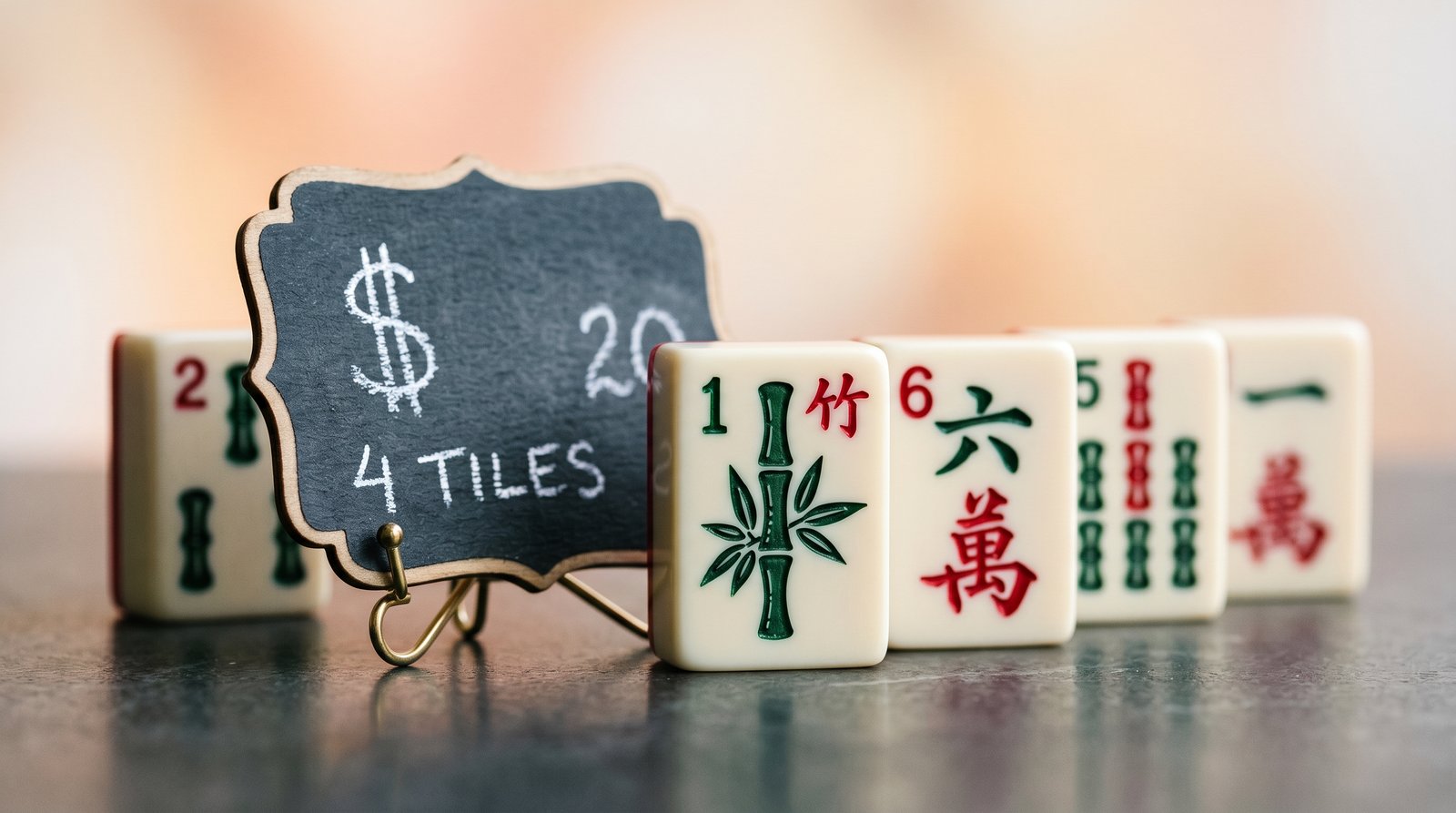
MahjongCompare maintains a directory of 201 American Mahjong teachers across the United States, with pricing that breaks down by format:
| Format | Typical Range | Per-person, per hour |
|---|---|---|
| Private (1-on-1) | $50-70/hour | $50-70 |
| Small group (4-6) | $25-40/person/hour | $25-40 |
| Large group (7+) | $20-30/person/hour | $20-30 |
| Series package (4-5 sessions) | $175-400 total | Varies |
These are list prices. They don't account for regional variation (a Manhattan instructor charges differently than one in suburban Tennessee), travel fees, or materials. They also don't tell you whether the instructor at those prices is making money or subsidizing her club with her retirement fund.
The range that matters if you're running a club or teaching out of your dining room: small-group instruction at $25-40 per person per hour is where most of your business probably lives. That's the rate to benchmark against, and it's the one most instructors set too low.
The math most instructors don't do
Let's run a real scenario. You teach a two-hour small-group lesson for four students at $30 per person.
Gross revenue: $120
Costs:
- Equipment depreciation: $5
- Materials (cards, guides): $3
- Travel (20 min each way): $12
- Space (home, allocated): $10
- Prep and cleanup (25 min): $0 (unpaid)
- Admin time (15 min): $0 (unpaid)
Net revenue: $90
Total time invested: 3 hours (2 teaching + 0.67 travel + 0.42 prep/cleanup + 0.25 admin)
Effective hourly rate: $30/hour
That looks acceptable until you realize you're not accounting for no-shows (which happen), cancellation gaps you can't fill, seasonal slowdowns, the weeks you spend marketing instead of teaching, or the cost of the certification course or teacher training you invested in. Lara's Mahjong Edit runs a "Build Your Table" business program specifically for mahjong teachers, and the fact that it exists tells you something: the business side of teaching mahjong is hard enough that someone built a course around it.
The real effective rate for most instructors at $30/person is closer to $18-22/hour when you account for all the time and costs that don't appear on the invoice.
Five pricing mistakes that keep instructors stuck
1. Pricing by feel instead of by formula
"I charge what feels fair" is the most common answer when you ask an instructor how she set her rates. Fair to whom? If you haven't calculated your costs, you don't know whether your price is fair to you. Run the math above with your actual numbers. If the effective hourly rate wouldn't be acceptable for any other skilled professional service, your price is too low.
2. Anchoring to the lowest competitor
There will always be someone charging less. Maybe she teaches from home with no travel costs. Maybe she's retired and doesn't need income. Maybe she's losing money and doesn't know it. The cheapest instructor in your area is not your benchmark. The median rate for your format and market is. MahjongCompare's directory is a good place to survey the range.
3. Never raising prices
If you started at $25/person two years ago and you're still at $25/person, you've given yourself a pay cut. Inflation, rising material costs, and your increasing experience all justify a price increase. Most students won't blink at a $5 bump communicated with four weeks' notice. The ones who leave over $5 were never going to be your long-term players.
4. Charging the same rate for every format
Private instruction, small groups, large groups, and series packages should all have different per-person rates. Your time investment is similar regardless of group size, which means your per-person rate should decrease as group size increases, but your total session revenue should increase. A private lesson at $60/hour and a four-person group at $30/person/hour means you make $60 alone and $120 with four. That's the right direction.
5. Ignoring the series discount
A student who commits to a five-session beginner package is worth more than five individual bookings, because she's guaranteed revenue, lower admin overhead, and a higher completion rate. Offer a 10-15% discount on series packages. If your per-session rate is $35/person, a five-session package at $150 ($30/session) locks in $150 of committed revenue versus five uncertain $35 bookings.
How to set your price: a framework
Step 1: Calculate your loaded cost per session. Include every cost from the list above. Be honest about travel, prep, and admin time.
Step 2: Decide your target hourly rate for all time invested. Not just teaching time. All time. A reasonable target for a skilled instructor in most U.S. markets is $40-60/hour. In high-cost markets (New York, San Francisco, Los Angeles), $60-80 is appropriate.
Step 3: Back into your per-person price.
Formula: (Target hourly rate x Total hours invested + Loaded costs) / Number of students = Minimum per-person price
Example: ($50/hour x 3 hours + $30 costs) / 4 students = $45/person
If that number is higher than what you're currently charging, you've confirmed the underpricing.
Step 4: Check against market rates. If your calculated price is within the MahjongCompare range ($25-40 for small groups), you're in the market. If it's above, you need to either justify the premium (better materials, more experienced instruction, included NMJL card) or reduce your costs (teach at home, batch sessions geographically).
Step 5: Build a price menu. Offer three formats at three price points: private, small group, and series. As the Splash of Color Co blog notes, there's no formal certification required to teach NMJL mahjong, so your credibility comes from your experience, your materials, and your students' outcomes, not from a credential. Price accordingly.
Per-session pricing vs. dues-based membership
There's a fork in the road that separates "instructor" from "operator."
Per-session pricing works when you're teaching beginners: each lesson is a discrete product with a clear start and end. But once those beginners graduate to regular play, the pricing model should shift.
A dues-based membership (monthly or quarterly) creates predictable recurring revenue, reduces per-session admin, and psychologically shifts the relationship from "I'm paying for a class" to "I belong to a club." The operator who charges $40/month for weekly play and runs four tables is making $640/month in recurring revenue from 16 members, with zero per-session invoicing.
The transition from per-session to membership is where most instructors stall, because it requires thinking like a business operator rather than a freelance teacher. But it's also where the economics start working in your favor.
When to raise your prices
Three signals that it's time:
-
You're turning people away. If your sessions fill consistently and you have a waitlist, your price is below market-clearing. Raise it until you're filling 80-90% of seats without a waitlist.
-
Your effective hourly rate is below your target. Run the math quarterly. If costs have crept up or you've added services (materials, follow-up coaching, online resources), your price should follow.
-
It's been more than 12 months. Annual price increases are normal in every service industry. A 5-10% annual bump, communicated professionally and in advance, is expected by anyone who's ever belonged to a gym, a golf club, or a yoga studio.
How to communicate it: Four weeks' notice, in writing, with a brief explanation. "Starting July 1, group lesson rates will increase from $30 to $35 per session to reflect updated materials and our expanded curriculum. Current series packages will be honored at the existing rate through their completion." That's it. No apology, no lengthy justification.
The bottom line on pricing
Your mahjong instruction is a professional service delivered by a skilled teacher using expensive equipment in someone's limited free time. Price it like one. The operators who thrive long-term aren't the ones with the lowest rates. They're the ones who ran the math, set a sustainable price, and invested the margin back into better materials, better spaces, and a better experience for their players.
If you're running the numbers and realizing the spreadsheet side of your club is eating into the time you'd rather spend teaching, book a demo with Mahjician and see how the dues, scheduling, and roster management can run in the background while you focus on the game.