The Mahjong Boom Is Real: What the Numbers Mean for Your Club
Yelp searches for mahjong clubs surged 4,467%. Eventbrite events nearly tripled. Oh My Mahjong hit $30 million. Here is what the boom actually means for the person running the tables.
By Trey Peirce
TL;DR. American Mahjong is in the middle of a genuine boom. Yelp searches for mahjong clubs surged 4,467% year-over-year. Eventbrite mahjong events grew 179% between 2023 and 2024. Oh My Mahjong crossed $30 million in annual revenue from a $10,000 self-funded start. Dedicated mahjong studios are opening in Dallas, Cleveland, Brooklyn, and beyond, and retail real estate analysts are comparing the trajectory to pickleball. If you run a club, teach lessons, or manage a community mahjong program, these numbers are not just interesting. They are your market signal. Here is what they mean, what is driving them, and how to position your operation to ride the wave instead of getting swamped by it.
The Numbers Behind the Noise
You have probably felt the energy shift already. More inquiries from new players. Waitlists that did not exist two years ago. Students bringing friends who have never touched a tile. But feelings are not business cases. Numbers are.
Yelp data (September 2024 through August 2025): Searches for "mahjong clubs" surged 4,467% year-over-year. Searches for "mahjong lessons" rose 819% in the same period. Yelp named mahjong a top trend of 2026.
Eventbrite data: Mahjong events on the platform grew 179% nationally from 2023 to 2024. In San Francisco specifically, event frequency spiked nearly 150%. These are not existing players showing up more often. These are new events pulling new audiences.
Market size: The global mahjong set market was valued at $1.2 billion in 2024, projected to reach $2.1 billion by 2033 at a 6.5% compound annual growth rate, according to MarketIntelo and GrowthMarketReports. North America's slice: $185 million, growing at 6.2% CAGR.
Membership signal: The National Mah Jongg League counts over 350,000 members in the United States. That number has been climbing steadily, and the annual card release every April 1 sells out faster each year.
These are not vanity metrics. Yelp searches represent people actively looking for a place to play. Eventbrite growth represents organizers seeing enough demand to spin up new events. Market projections represent capital flowing into an industry because analysts see sustained growth. If you run a club, this is the demand curve you are sitting on.
Who Is Driving the Boom
The old stereotype of mahjong as a game for retired women at the JCC has not been accurate for years. The boom is being fed by multiple demographic streams converging at once.
Younger Players Are Arriving
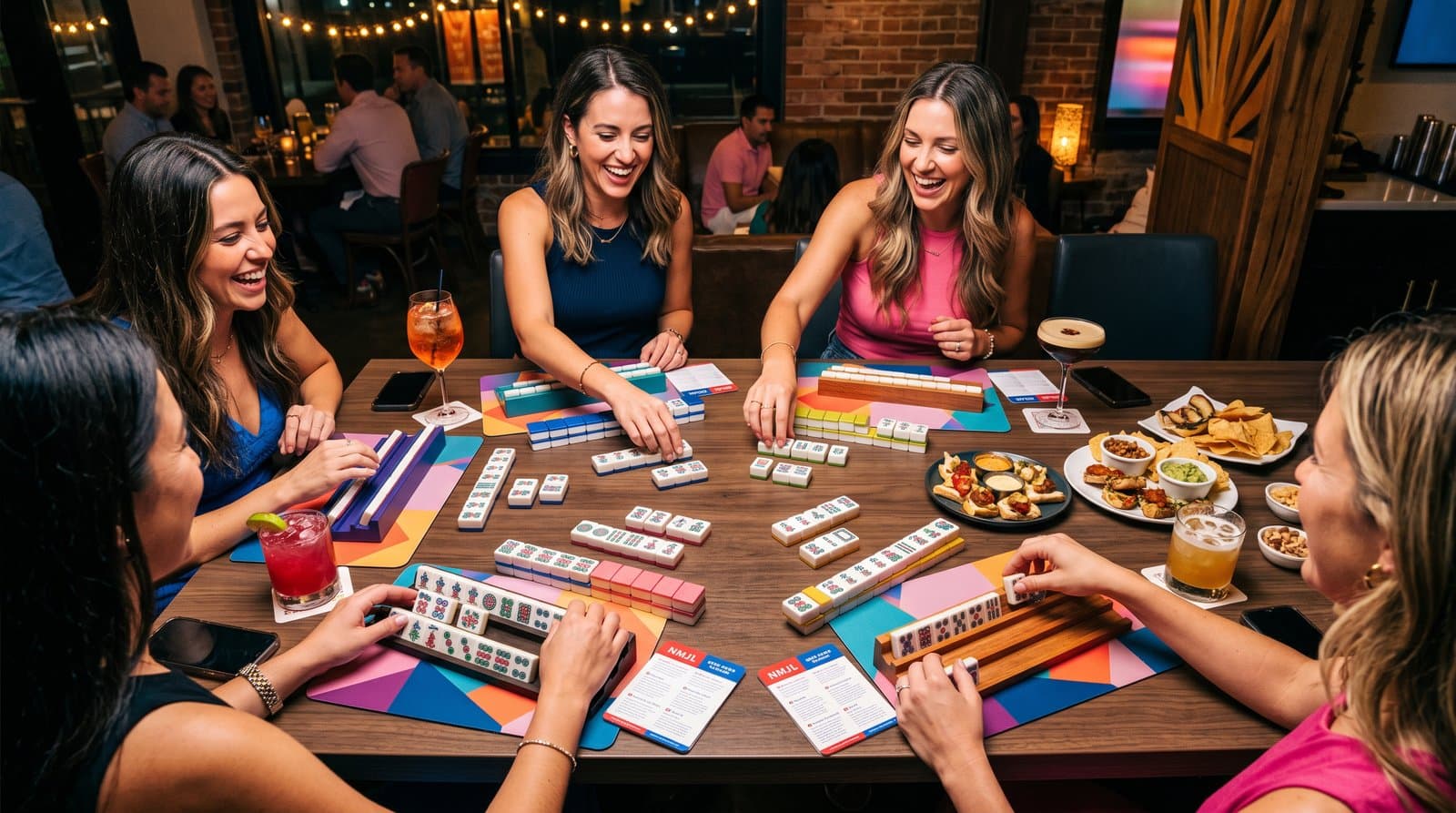
The game has moved well beyond its historical association with older Jewish and Asian American women. Players in their twenties and thirties are showing up at bars, restaurants, and pop-up events.
The Green Tile Social Club in Brooklyn started with a small gathering at a waterfront park in 2022. By January 2025, their events were drawing 700 attendees to a warehouse, complete with mahjong tile tattoo stations and omakase service. That is not your grandmother's card night. (Though your grandmother would probably love it.)
Nicole Wong, author of Mahjong: House Rules from Across the Asian Diaspora and founder of The Mahjong Project, told NPR's Here and Now: "People are gravitating to it as an activity in the same way people went to trivia nights when I was in my twenties. Plus, when it comes to younger generations in Asian American communities, I think there is a curiosity and pride about cultural heritage that is more celebrated now."
The Business Side Is Booming
Oh My Mahjong, the Dallas-based tile set company founded by Megan Trottier in 2022 with a $10,000 investment, surpassed $30 million in annual revenue by October 2025. That is 360% year-over-year growth. They sell one mahjong mat every 10 seconds in the U.S. and have certified over 1,000 instructors through their Mahji Mentorship Program.
The tile set market has become genuinely competitive. Oh My Mahjong, The Mahjong Line, and a growing roster of boutique brands are releasing seasonal drops that sell out in minutes, more closely resembling sneaker culture than board game retail. D Magazine's February 2026 feature, "The Magnates of Mahjong," profiled the Dallas rivalry between these companies, calling the city "a very mature mahjong city."
Dedicated Studios Are Opening
The clearest signal of a maturing market: people are signing leases.
The Charleston Club in Dallas opened in October 2024 with a 1,500-square-foot dedicated space. Tables range from $945 to $4,800. The Mahjong Maison in Cleveland opened in January 2026 at 1,300 square feet, hosting 32 players for Monday league play. Sparrow's Nest Studio in New York City bills itself as the city's first venue dedicated exclusively to mahjong learning and play.
Real estate professional Daniel Poku of SRS Real Estate Partners is now actively brokering dedicated mahjong studio leases, telling ICSC Exchange that the trajectory mirrors pickleball. When commercial real estate brokers start specializing in your game, the boom is not a fad.
Why Now: The Forces Behind the Surge
No single cause explains a 4,467% search increase. The boom is a compound effect of several forces hitting simultaneously.
The Pandemic Aftershock
COVID-19 isolation created pent-up demand for in-person, screen-free social activities. But the pandemic's impact on mahjong runs deeper than generic socializing. For Asian American communities specifically, the surge in anti-Asian hate during 2020 and 2021 prompted a wave of cultural reclamation. Mahjong, as a game with deep Chinese roots now played across diverse American communities, became a vehicle for that reclamation.
Nicole Wong draws this connection explicitly: younger Asian American players are approaching the game with "a curiosity and pride about cultural heritage that is more celebrated now, in the wake of the anti-Asian hate we saw in the pandemic."
The Third Place Phenomenon
Studio owners consistently describe their spaces as "third places," the sociologist Ray Oldenburg's term for gathering spots that are neither home nor work. Amy Myers of The Mahjong Maison told ICSC Exchange: "We're all looking for somewhere to go, and we want it to feel good when we get there."
This framing matters for operators. You are not selling a game. You are selling belonging. The clubs, studios, and community programs that understand this distinction are the ones filling tables and building waitlists.
Media and Celebrity Amplification
The press has noticed. The Washington Post ran "Forget partying. Saturdays are for mah-jongg" in July 2025. Smithsonian Magazine featured "The Asian Game of Mahjong Is Trending in the West" in February 2025. The New York Times, Wall Street Journal, NPR, and NBC Bay Area have all published mahjong boom coverage in the past year.
Julia Roberts publicly disclosed she plays mahjong weekly with friends, cited across multiple outlets. Luxury hotels like The Standard in New York's East Village now host mahjong nights for guests. When celebrities and luxury brands adopt an activity, it signals cultural mainstream status, not niche hobby.
The "New Pickleball" Narrative
ICSC, the retail real estate industry group, published an analysis explicitly asking: "Is Mahjong the Next Pickleball?" Historian Annelise Heinz weighed in: "Part of why it has been so enduring, so endlessly revisited, and why I think we're having this renaissance today is because of the way it can help people connect and build community."
The pickleball comparison is instructive. Pickleball went from niche retirement activity to $1.5 billion industry in about a decade. It succeeded because it was social, accessible, and required dedicated venues. Sound familiar?
What This Means for Your Operation
Numbers are interesting. Strategy is useful. Here is how to translate the boom into operational decisions.
Your Waitlist Is Your Moat
If you are already running a club or studio, the boom is filling your pipeline. The operators who win are the ones who convert interest into recurring memberships, not one-off sessions. A structured onboarding process (beginner bootcamp, first three sessions guided, assigned to a regular table by week four) turns boom-curious visitors into long-term players.
Beginner Programming Is the Bottleneck
The single most common complaint in mahjong Facebook groups: "I want to learn but I can't find a class." Oh My Mahjong has certified over 1,000 instructors through their mentorship program, and demand still outstrips supply. If you are not running beginner programs, you are leaving the highest-growth segment of the market to someone else.
The Annual Card Cycle Is Your Best Marketing Window
The NMJL releases a new card every April 1. Every player needs one. The weeks surrounding the card drop are the single best time to recruit new members, run workshops, and re-engage lapsed players. If you are not building your marketing calendar around April, you are ignoring the most predictable demand spike in the mahjong year.
Pricing Has Room to Move
With Oh My Mahjong selling mats at volume and boutique tile sets commanding $300 or more, the market has clearly signaled that players will pay for quality experiences. Studios like The Charleston Club in Dallas charge table fees in the thousands. You may not be in that tier, but if you are still charging $5 per session because "that's what we've always charged," the market has moved past you.
Younger Players Want Different Things
The 25-year-old who discovered mahjong at a Brooklyn pop-up event has different expectations than the 65-year-old who has played every Tuesday for 20 years. They want evening hours, contemporary spaces, social media-friendly environments, and probably a drink menu. Serving both demographics is possible, but it requires intentional programming, not one-size-fits-all scheduling.
The Cultural Conversation Requires Care
The Mahjong Line controversy of 2021 (a Dallas company removed Chinese characters from tiles and faced a cultural appropriation backlash that led to a public apology) demonstrated that the mahjong community cares deeply about cultural respect. As an operator, you do not need to be an expert in cultural studies, but you do need to approach the game's Chinese heritage with genuine respect and awareness. Feature the history. Acknowledge the roots. Your players will notice and appreciate it.
The Boom Will Not Last Forever (But the Growth Will)
Every boom eventually normalizes. The 4,467% Yelp search increase will not repeat next year. But the structural forces behind the growth (social connection demand, demographic diversification, commercial infrastructure development, media attention) are durable. The mahjong market is not spiking. It is shifting to a permanently higher baseline.
Historian Annelise Heinz, who has studied mahjong's American journey across decades, frames it well: the game has been "endlessly revisited" because its core value proposition (social connection through structured play) never goes out of style. What changes is who is playing, where they are playing, and what they expect from the experience.
The operators who build for the next five years, not just the next five months, are the ones who will still be running full tables when the headlines move on to the next trend.
If managing that growth (the waitlists, the dues, the sub requests, the scheduling chaos) is becoming the hardest part of your week, book a 30-minute demo with Mahjician and see how a system built for mahjong operators handles the operational side while you focus on building the community your players showed up for.