
How to Build a Mahjong Schedule That Fills Every Table
The right weekly schedule is the single highest-leverage decision you'll make as a mahjong club operator. Start with one anchor session, add only when your waitlist hits four, and segment by skill level before you segment by day.
By Trey Peirce
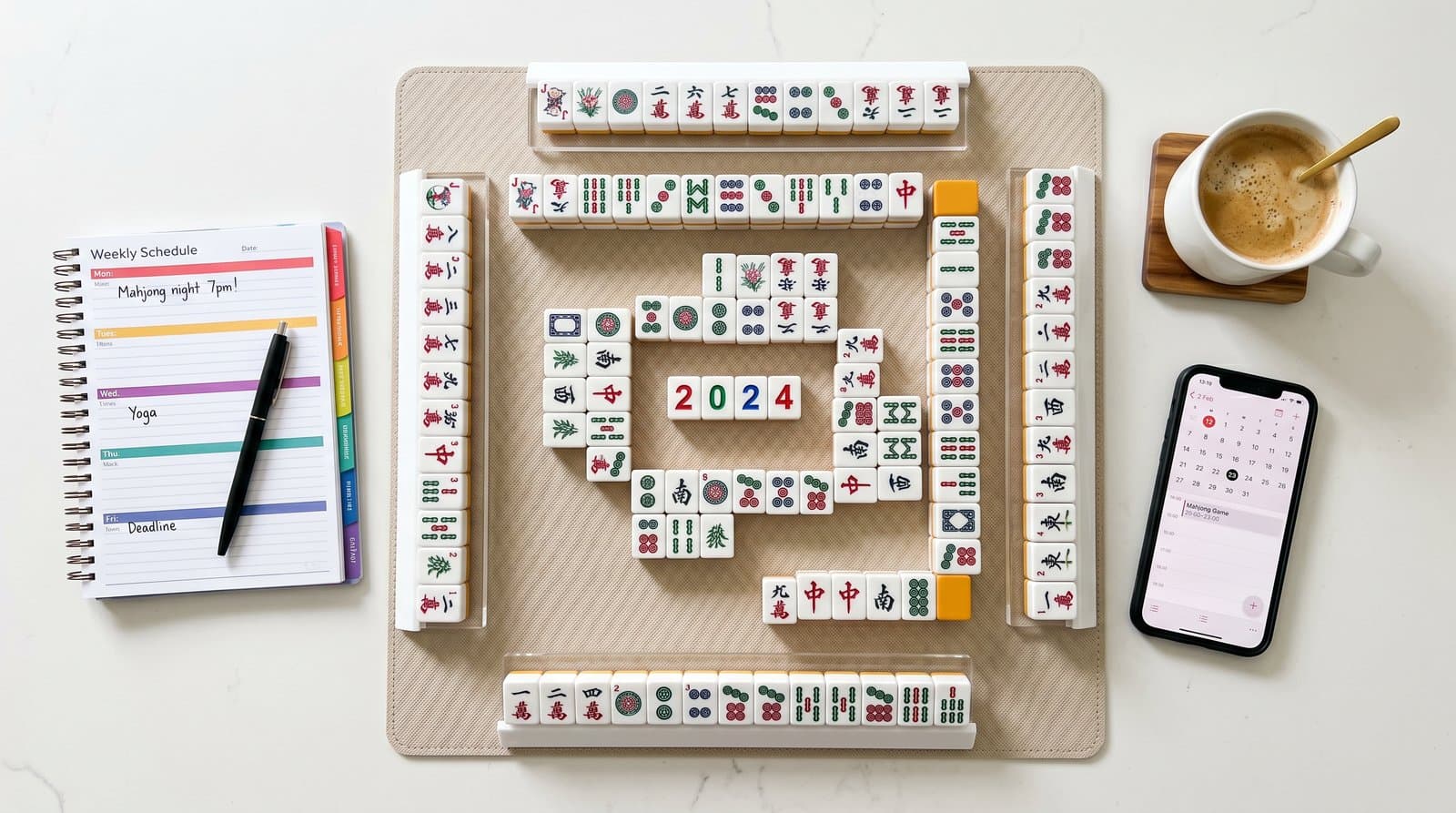
TL;DR. The right weekly schedule is the single highest-leverage decision you'll make as a mahjong club operator. Start with one anchor session at your strongest time slot, add sessions only when your waitlist consistently hits four or more, and segment by skill level before you segment by day. Most operators run too many sessions too soon, then wonder why Tuesday nights feel empty.
You posted one session, it filled up, so you added three more. Now Tuesday nights are a ghost town, your Wednesday regulars are unreliable, and you're spending Sunday morning chasing confirmations through a group text that has 47 unread messages.
This is the most common scheduling mistake mahjong club operators make. The fix is not a better spreadsheet. The fix is a scheduling framework built around real demand, not optimism.
This guide covers how to build a mahjong club schedule that fills every table, keeps your regulars coming back, and gives you a clear signal for when to grow.
Start With One Anchor Session
Every sustainable mahjong club schedule is built on a single anchor session: the one time slot where your best players show up consistently, where the room fills without reminders, and where energy is high enough that new players want to come back.
You probably already know what that session is. It is the Tuesday morning your founding group has claimed for eighteen months, or the Saturday afternoon that always has a waitlist.
If you are just starting your club, you do not have enough data to know yet. Pick the time slot that fits the most likely availability of your core demographic, run it consistently for six weeks, and track attendance every single time.
Do not add a second session until the first one is reliable. Reliable means four tables (16 players) showing up with minimal cancellations for at least four consecutive weeks.
The anchor session is your baseline. Everything else is an expansion decision.
The Four-Table Threshold
Four players fill one table. Sixteen players fill four tables. That is your minimum viable room: four full tables running simultaneously for a three-hour session window.
Most clubs operate in spaces that seat between four and eight tables. At four tables, you have a lively room where players can hear the energy from adjacent games. Below four, even two or three good players can feel like they are playing in a library.
The threshold rule is simple: before you add any new session to your mahjong club schedule, your existing anchor session must have a consistent waitlist of four or more players.
Not an occasional waitlist. A waitlist that rebuilds itself within 24 hours of opening spots, across at least three consecutive sessions.
That waitlist represents one new table of demand. When the waitlist reliably hits four, you have earned the right to add a second session or expand your current one.
If the waitlist never hits four, adding more sessions does not solve your attendance problem. It dilutes it. You will spread the same 14 players across two sessions and wonder why both feel thin.
Segment by Skill Level, Not by Day
New operators default to segmenting sessions by day: Mondays, Wednesdays, Fridays. The problem is that day segmentation does not protect the experience of your advanced players or your beginners.
When a first-year player sits at a table with three NMJL veterans who have been playing together for a decade, nobody has a good time. The beginner is lost, the veterans are frustrated, and the session pace breaks down.
Segment by skill level first, then assign those segments to days.
A workable three-tier structure for most clubs:
- Foundations: Players in their first six months, still learning the card, comfortable with slower play.
- Intermediate: Players who know the card, can hold their own, but are not yet calling tiles on instinct.
- Open/Advanced: Experienced players, fast pace, competitive table dynamics.
You do not need a formal rating system. A short intake form when players register, combined with a self-assessment question and your own observation after one session, gives you enough information to place people correctly.
The skill-segmented session serves your advanced players by protecting the pace they expect. It serves your beginners by giving them a room where asking questions is normal.
Pick Time Slots That Match Your Members
Your mahjong club schedule lives or dies on whether the time slots match the real-world availability of your members.
NMJL clubs skew toward players who are retired or have daytime flexibility. According to data from the National Mah Jongg League, the overwhelming majority of NMJL card purchases come from women over 55, many of whom are retired or semi-retired. Morning sessions between 10 a.m. and 1 p.m. often outperform evening sessions for this demographic.
If your membership skews younger, or if you teach at a studio that draws working-age adults, evenings and weekends will perform better.
Before you finalize any time slot, do a quick survey of your existing players or waitlist. Ask one question: "Which time windows work for you each week?" Give them a grid of options and let the results guide you.
Three-hour session windows are the standard for NMJL play. That means a 10 a.m. start ends at 1 p.m., a 12 p.m. start ends at 3 p.m., and a 6 p.m. start ends at 9 p.m. Build your time slots around natural stopping points that do not bleed into mealtimes or rush hours.
Avoid starting sessions at times that force players to arrive during peak traffic. If your studio is in a suburban area, a 5 p.m. Tuesday start means half your players are arriving stressed and late.
Build Your RSVP System Before You Need It
Group texts are free and they will cost you hours every week.
When your club has 12 players, managing RSVPs through a group chat is manageable. When you have 35, 50, or 80 players across multiple skill tiers and time slots, the group text becomes a wall of noise. You are hunting for confirmations, chasing non-responders, and manually updating a spreadsheet while trying to remember who owes you dues from last month.
The RSVP system you need has four components:
- A fixed registration window. RSVPs open at a set time (say, Sunday at 6 p.m. for the following week) and close 48 hours before the session. Players who do not register by the cutoff go to the waitlist.
- A waitlist with automatic promotion. When a registered player cancels, the first person on the waitlist gets notified automatically, not via a group text asking "who wants to come Tuesday?"
- A confirmation requirement. Waitlisted players who are promoted have a window (two to four hours is reasonable) to confirm before the spot passes to the next person.
- A dues-attached registration. Players confirm their spot by paying for the session, which eliminates the Venmo reconciliation nightmare you are currently doing on Sunday nights. For more on structuring this, see our guide on dues collection.
Set this system up before your club grows, not after. Retrofitting a payment and RSVP process onto an existing group text culture is ten times harder than building it from the start.
Handle Cancellations With a Real Policy
A cancellation policy is not about being strict. It is about protecting the four players who show up reliably and the people sitting on your waitlist who would have come.
When players cancel with no notice, two things happen. The waitlisted player loses a spot they would have taken. The three remaining players at the table either play a three-handed variant or break up to fill other tables, which creates a cascade of awkward table reconfiguration.
A functional cancellation policy for a mahjong club schedule has three elements:
A notice window. Require cancellations at least 24 to 48 hours before the session. Anything inside that window is a late cancellation.
A consequence for late cancellation. This does not have to be punitive. Losing your priority registration status for the following session is enough of an incentive for most players to cancel on time.
A no-show policy. Repeated no-shows without notice should result in a probationary period where the player cannot register until they have demonstrated reliability. This protects your regulars and your waitlist.
Put the policy in writing. Include it in your registration flow so every player acknowledges it when they sign up. Verbal agreements dissolve when a conflict arises; a written policy holds.
For help thinking through sub requests and managing last-minute replacements without chaos, read our guide on managing subs.

Seasonal Adjustments That Keep Tables Full
A mahjong club schedule that works in October will underperform in July. Attendance follows predictable seasonal patterns, and operators who ignore them end up over-scheduled in slow periods and under-scheduled when demand spikes.
Summer: Many clubs see a 20 to 30 percent attendance drop from Memorial Day through Labor Day. Players travel, grandchildren visit, and routines break. Consolidate sessions during this window rather than trying to sustain a full schedule with lower demand. Fewer, fuller sessions preserve the energy in the room.
Holidays: The two-week window around Thanksgiving and the stretch from mid-December through early January are slow for most clubs. Schedule accordingly. Running a "holiday session" as a special event (different format, festive setup) can maintain engagement without the pressure of a regular session that half-fills.
April (NMJL card drop): The new NMJL card releases in April every year. This is one of the highest-engagement moments for NMJL clubs. Demand for play sessions often spikes as players want to work with the new card. If you run a teaching component at your club, this is the right moment to add a temporary Foundations session for new players who just bought their first card.
Fall enrollment surge: September through November tends to be the strongest growth period for clubs that promote actively. If you are going to add a new session tier or skill-level segment, plan to launch it in early September when new-player interest is highest.
Track your attendance by week, not just by month. You will see patterns in your own data that are more specific to your market than any general guide can provide.
The Weekly Rhythm That Works
Most clubs that run successfully at scale operate on a simple weekly structure, not a complicated one.
A club with 40 to 60 active players typically runs well on two sessions per week: one weekday morning for the daytime-availability demographic and one weekend slot (Saturday morning or Sunday afternoon) for players who work during the week.
Each session has a defined skill tier. The weekday morning may be Intermediate/Open, while the weekend slot runs two simultaneous tiers (a Foundations table in one corner, an Open table on the other side of the room).
The registration cycle runs on a weekly cadence: RSVPs open Sunday evening, close Thursday, waitlist promotions happen Thursday night, and final headcount is locked Friday morning. That gives you the weekend to handle any last-minute logistics without it bleeding into your personal time.
Dues are collected at registration, not at the door. Table assignments are communicated the day before the session so players arrive knowing where they are sitting.
This is not an exciting framework. It is a functional one, and functional is what keeps your tables full month after month.
When to Add Your Second Session
You have a reliable anchor session. Your waitlist consistently hits four. Your cancellation policy is in writing. Your RSVP system collects dues automatically.
Now you can add a second session.
The decision about which session to add should follow the data from your waitlist. If your Wednesday morning waitlist is always three retired teachers, add a second Wednesday morning session before you add a Thursday evening. Serve the demand that is already showing up, not the demand you hope will materialize.
When you add the second session, do not simply clone the first one. Use the expansion as an opportunity to add a skill-tier you are not currently serving. If your anchor session is Intermediate/Open, add a Foundations session for the players who have been asking when they can start.
Give the new session six weeks before you evaluate it. Attendance at a new session always starts lower than an established one. Players need time to adjust their routines. As long as the session reaches two full tables (eight players) by week three and shows upward momentum, it is on track.
If it is still at one table after six weeks, look at the time slot, the skill tier, and your promotional effort before you decide to cut it.
Stop Guessing, Start Tracking
Every decision in this guide is better when it is backed by your own data: attendance by session, waitlist depth by week, cancellation rates by player, and seasonal attendance trends over time.
Most operators track nothing, or track it inconsistently in a spreadsheet that gets updated when they remember to. That means every scheduling decision is a guess dressed up as intuition.
The minimum viable tracking setup for a mahjong club schedule is:
- Headcount per session (registered vs. actual attendance)
- Waitlist count at the time RSVPs close
- Number of late cancellations and no-shows per session
- Monthly revenue per session (so you can see which sessions are carrying the club financially)
You do not need sophisticated software to start. A consistent spreadsheet updated after every session will surface patterns within two months.
What you are looking for: which sessions consistently reach four full tables, which sessions plateau below that threshold, and when your waitlist starts signaling new demand. Those three data points drive every expansion and consolidation decision.
The clubs that grow reliably are not the ones run by the most charismatic instructors. They are the ones run by operators who track their numbers and make decisions based on what the data shows, not on what feels right in the moment.
If building and adjusting your weekly schedule still feels like guesswork, Mahjician can help. Our platform handles RSVPs, waitlist management, dues collection, and session tracking in one place, so you can spend your time on the game instead of the logistics. Book 30 minutes with us and we will walk through your current schedule together.