
How to Start a Mahjong Club That Survives Month Three
Starting a mahjong club is easy. Keeping it alive past twelve weeks is the hard part. This guide covers the ten decisions that separate clubs that thrive from clubs that quietly dissolve.
By Trey Peirce
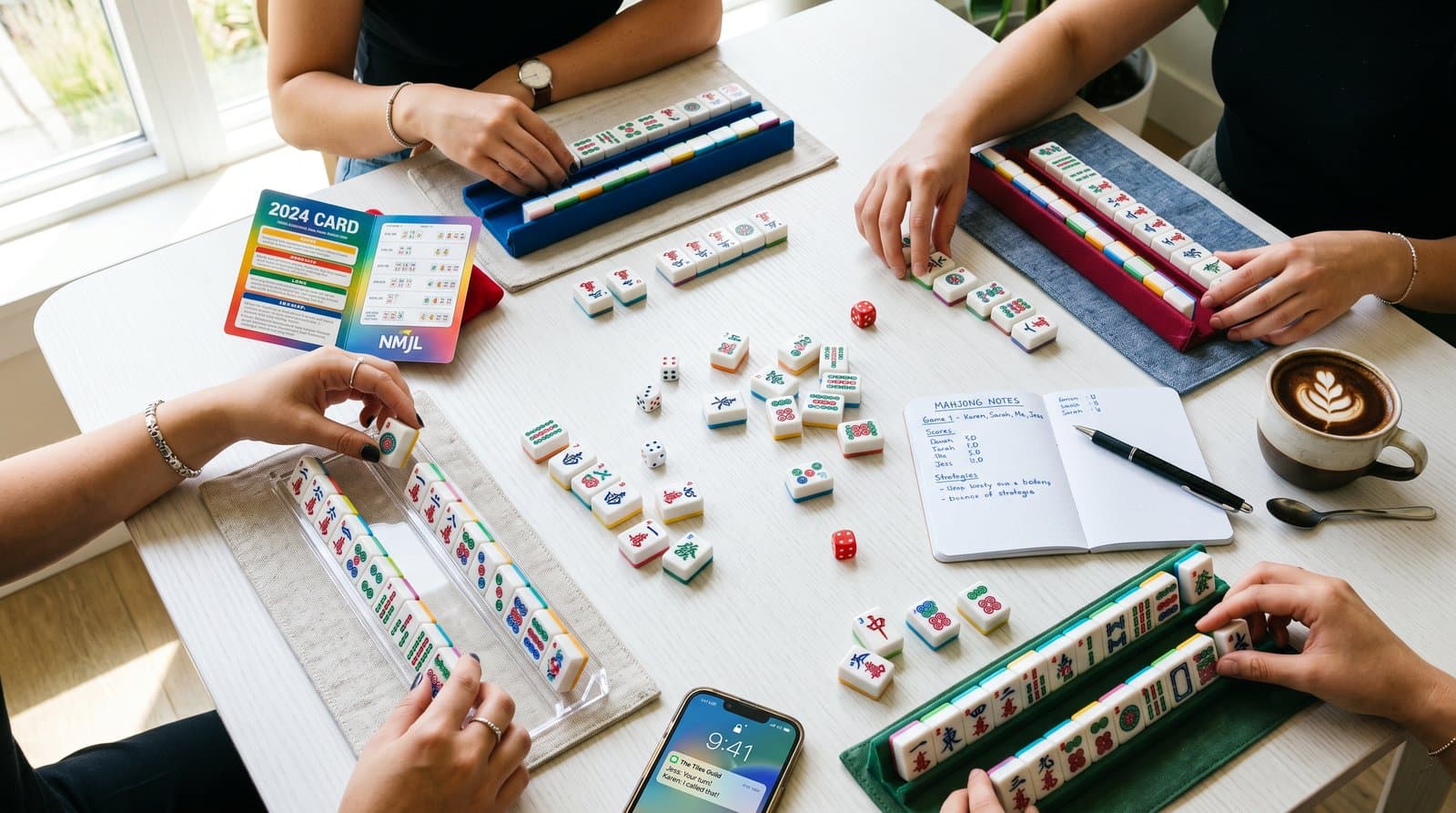
TL;DR. Starting a mahjong club is easy. Keeping it alive past twelve weeks is the hard part. The clubs that survive treat the operation like a small business from day one: they charge dues early, build a sub list before they need it, pick a location that scales, and delegate before the organizer burns out. This guide walks through the ten decisions that matter most in your first 90 days.
You need four players, a table, a set, and an NMJL card. That part takes an afternoon. The part that takes real work is everything that happens after the first session ends and you realize you just signed up to coordinate schedules, collect money, manage personalities, and recruit replacements for the two people who ghosted your group text. Starting a mahjong club is a logistics problem disguised as a social one, and the organizers who treat it that way from day one are the ones still running sessions a year later.
The Demand Has Never Been Higher
American mahjong is in the middle of a genuine boom. Yelp reported a 4,500% increase in searches for "mahjong" over the past five years. Eventbrite saw a 179% jump in mahjong-related event listings in a single year. The National Mah Jongg League has grown past 350,000 members, and new clubs are popping up everywhere from Brooklyn to Fort Worth.
This isn't a TikTok fad. The core demographic (women 45 and older, though the player base is getting younger and more diverse every year) has real spending power and real time to commit. When someone walks into your club for the first time, she's probably already watched YouTube tutorials, ordered a set on Amazon, and tried to teach herself from the NMJL card. She's ready. She just needs a place to play.
The supply side hasn't caught up. In most metro areas, there are more people searching for mahjong clubs than there are organized clubs to find. If you've been thinking about starting one, the timing has never been better. But timing doesn't protect you from the operational mistakes that kill most new clubs before they hit their stride.
Why Most Clubs Die by Month Three
Club death isn't dramatic. Nobody storms out. Nobody sends a breakup text. What happens is quieter and harder to fix: the organizer gets tired.
Here's the pattern. You start with eight or twelve enthusiastic players. The first few sessions are electric. Then someone cancels Tuesday morning and you spend 45 minutes texting through your contact list looking for a sub. Then someone else asks if they can bring a friend who's "sort of played before" and you spend the session teaching instead of playing. Then dues collection gets awkward because three people haven't Venmoed you yet and you don't want to nag. Then you skip a week because you're exhausted, and when you come back, two regulars have found another group.
The clubs that die by month three almost always share the same failure points:
- Solo-organizer burnout. One person handles every text, every sub request, every payment reminder. This is the number-one killer.
- No money changing hands. Clubs that don't charge dues lack the structure to feel like a real commitment. Players drift.
- Table math problems. NMJL requires exactly four players per table. Three is useless. Five is awkward. Without a reliable sub system, one cancellation torpedoes an entire session.
- No house rules. Ambiguity about pace, phone use, teaching expectations, or scoring creates friction that builds silently until someone just stops showing up.
- The founder plays teacher instead of player. If you spend every session guiding beginners instead of playing your own hand, you'll resent the club you built.
Every one of these is preventable. Here's how.
Step 1: Decide What You're Building
Before you recruit a single player, answer this: are you building a casual play group, a structured club, or a teaching studio?
A casual play group meets once a week, maybe at someone's house. Four to eight people. No money, minimal coordination. This is fine if everyone is a close friend and nobody cancels. It falls apart the moment you need a sub.
A structured club has regular sessions, a roster, dues, and house rules. Sixteen to sixty members. This is where most successful organizers land. It's small enough to manage but large enough to absorb cancellations.
A teaching studio combines instruction with organized play. You're charging for lessons, running beginner tracks alongside intermediate and advanced tables, and managing what is effectively a small business. If you're an NMJL instructor, this is probably where you're headed even if you don't realize it yet.
Know which one you're building. The operational decisions downstream (pricing, location, scheduling) all depend on this answer. Most club death happens because someone built a casual play group and accidentally attracted structured-club-level demand without upgrading the infrastructure to match.
Step 2: Find Your Core Four
You don't need twenty members to launch. You need four. Specifically, you need four people who will show up every single week without being reminded. These are your core four, and they're the foundation everything else gets built on.
Your core four should be intermediate or advanced players. Not beginners. You'll add beginners later, once you have the bandwidth to teach without sacrificing your own game. Right now, you need four people who know the rules, own a set, and can commit to a consistent weekly slot.
Where to find them: Facebook groups like "Mah Jongg, That's It!" (67,000+ members) and "Mahj Life Community" (55,000+ members) are where operators find their first players. Post your city, your preferred day and time, and the level of play you're targeting. Be specific. "Looking for intermediate NMJL players for a Thursday morning group in Scottsdale" will get you better responses than "anyone want to play mahj?"
Step 3: Pick a Location That Scales
Your dining room works for four players. It does not work for sixteen. Think about where you'll be in six months, not just where you are today.
Home games are free and comfortable, but they cap your growth. You can't charge meaningful dues for a session at your kitchen table, and you can't fit more than two tables without it feeling cramped.
Rented spaces (community centers, church halls, JCC activity rooms) cost $50 to $200 per session but signal that this is a real club. They also give you room to grow. Many JCCs and senior centers will give you the space free if you're willing to open your sessions to their members.
Dedicated studios are the end game for serious operators. You control the schedule, the environment, and the experience. But don't sign a lease until you've proven demand with at least three months of consistent attendance somewhere cheaper.
The location decision is really a bet on how big you think this will get. Most successful clubs start at someone's house, move to a rented space within two months, and either stay there or scale into a studio within a year.
Step 4: Set a Schedule and Protect It
Consistency beats frequency. One weekly session that never moves is better than three sessions that keep shifting around. Your players need to be able to block the time automatically without checking a group text every week.
Pick the day and time based on your target demographic. If you're serving retired players (the bulk of the NMJL base), weekday mornings and early afternoons are prime. Tuesday and Wednesday mornings are the sweet spot for most clubs. If you're targeting working professionals, weekday evenings or Saturday mornings work.
Once you set the schedule, protect it. Don't skip weeks. Don't move the time because one person has a conflict. The moment you start making exceptions, the club loses its rhythm, and players start treating attendance as optional.
Step 5: Charge Dues from Day One
This is the decision most new organizers get wrong. They don't charge because it feels awkward, or because they think free sessions will attract more players. Both instincts are wrong.
Charging dues does three things. First, it covers your real costs: table rentals, card sets, snacks, and the NMJL cards you'll buy in bulk every April. Second, it creates commitment. People who pay show up. People who don't pay drift. Third, it signals that this is a professionally run club, not a favor you're doing for friends.
How much? For a weekly play session, $10 to $20 per session or $40 to $80 per month is the standard range. If you're teaching, lessons typically run $25 to $50 per person for a group session, with private instruction at $75 to $100 per hour. Charge what covers your costs and values your time. Most instructors undercharge, and it catches up with them.
For the mechanics of actually collecting dues without awkward Venmo reminders, you need a system, not a spreadsheet.
Step 6: Build a Sub List Before You Need It
You will lose a player to a last-minute cancellation. It will happen on the day you have exactly four confirmed and no backups. This will happen repeatedly. The clubs that survive have a sub list ready before the first cancellation hits.
Your sub list should be at least twice as long as a single session's player count. If you run two tables (eight players), you need sixteen subs. That sounds like a lot. It isn't. Most subs can only play on certain days, and many will decline more often than they accept. You need depth.
Recruit subs the same way you recruited your core: Facebook groups, word of mouth, local meetups. Make clear that subs play on a "we'll text you when there's an opening" basis. Many players actually prefer this arrangement because it lets them play without committing to a fixed schedule.
Sub-request management is the operational problem that eats more organizer time than anything else. Get it right early, or it will grind you down.
Step 7: Write House Rules and Post Them
Ambiguity is the root of every table-side conflict. Don't let norms develop by accident. Write them down.
Your house rules should cover, at minimum:
- Pace of play. Is there a time limit per turn? What happens when someone consistently slows the table?
- Phone policy. Phones face down during play, or is checking between hands acceptable?
- Teaching at the table. Are advanced players expected to coach beginners mid-hand, or is teaching reserved for a separate beginner track?
- Scoring disputes. Who has the final call? Is there a designated referee?
- Cancellation policy. How much notice is required? What happens to no-shows?
- Guest policy. Can members bring friends? Do guests pay a different rate?
You don't need a ten-page document. A single laminated page at each table is plenty. The point isn't to be rigid. The point is to set expectations before friction builds into resentment.
Step 8: Recruit in Waves, Not All at Once
The biggest mistake new organizers make with recruitment is trying to go from four players to forty in a single push. Don't. Grow in waves of four to eight new members at a time, and give each wave a few weeks to integrate before adding more.
Why? Because each new wave changes the club's culture slightly. If you onboard too many beginners at once, your advanced players feel like they're running a classroom instead of playing the game they love. If you onboard too many strangers at once, the social cohesion that keeps people coming back gets diluted.
The NMJL card drop every April is your single best recruiting window. New and returning players are actively searching for clubs to practice the new card. Time your biggest recruitment push around card season (late March through May) and you'll ride the demand wave instead of fighting for attention.
Outside of card season, your best channel is referrals from existing members. Offer a "bring a friend" session once a month. Keep it low-pressure. Let the experience sell itself.
Step 9: Delegate Before You Burn Out
If you are the only person who knows the roster, collects the money, finds the subs, manages the group text, buys the snacks, and sets up the tables, you will burn out. It's not a question of if. It's a question of when.
Delegate early. Specifically, delegate these roles by the end of your first month:
- Sub coordinator. One person owns the sub list and handles fill requests. This single delegation will save you hours per week.
- Treasurer. One person collects dues and tracks expenses. Even if it's simple, separating the money from the organizer reduces awkwardness.
- Setup lead. One person arrives early and handles tables, chairs, and tile sets. You should not be the first one there and the last one to leave every single session.
You don't need formal titles. You need three people who each own one specific task. The organizer's job is to set the vision, grow the roster, and handle the decisions nobody else wants to make. Everything else should be shared.
Step 10: Think Like an Operator, Not a Hobbyist
The clubs that thrive past month three have organizers who think of themselves as operators, not just players who happen to host. This mindset shift changes everything.
An operator tracks attendance. She notices when someone has missed three weeks and reaches out. She watches the ratio of beginners to intermediates and adjusts her recruiting accordingly. She reviews her sub-request fill rate and adds to the list when it drops below 80%. She has a financial picture of the club: what comes in, what goes out, whether the pricing model is sustainable.
You don't need a business degree to do this. You need a system. A spreadsheet works for the first month. Beyond that, the complexity of managing schedules, dues, sub requests, and player communications across a growing roster will outpace what any spreadsheet can handle cleanly.
Your Month-Three Checkpoint
At ninety days, run this diagnostic on your club:
| Metric | Healthy | Warning |
|---|---|---|
| Weekly attendance rate | 85%+ of confirmed players show up | Below 70% means your commitment structure is weak |
| Sub fill rate | 80%+ of open seats filled within 24 hours | Below 60% means your sub list is too thin |
| Dues collection rate | 95%+ collected on time | Below 80% means your collection system needs work |
| New member pipeline | 2-4 inquiries per month | Zero inquiries means your visibility is a problem |
| Organizer hours per week | Under 3 hours outside of sessions | Over 5 hours means you're not delegating enough |
If three or more of those metrics are in the warning zone, you have an operational problem, not a demand problem. Go back through the ten steps above and figure out which one you skipped.
Frequently Asked Questions
How many members does a mahjong club need to be sustainable?
A minimum of 12 to 16 active members gives you enough coverage to run two tables consistently, even with cancellations. Most thriving clubs settle between 20 and 40 members. Beyond 60, you'll need multiple session times and likely a dedicated space.
Do I need to be an expert player to start a club?
You need to be comfortable enough with the rules to keep a game moving, but you don't need to be a tournament-level player. What matters more is organizational skill. The best club operators aren't always the best players. They're the best managers.
Should I start with American mahjong or another variant?
If you're in the US and targeting the largest possible player base, start with NMJL (American) mahjong. It's the dominant variant by membership count, with the National Mah Jongg League's 350,000+ members providing a built-in community. Other variants have passionate followings but much smaller organized scenes.
How do I handle a player who disrupts the table?
Address it privately after the session, not during play. Reference your written house rules. If the behavior continues, a direct conversation about expectations is necessary. Most organizers avoid this conversation and lose their best players as a result. The disruptive player is one person. The five quiet players who stop coming because of that person represent a much bigger loss.
When should I consider mahjong club management software?
The moment you catch yourself spending more time managing logistics than playing the game. For most clubs, that tipping point comes between 15 and 25 members, when the group text can't handle sub requests, the spreadsheet can't track who paid, and your Saturday morning prep takes longer than the session itself.
If that sounds like your week every week, you can book 30 minutes with us to see how Mahjician handles the operational side so you can get back to playing.