
Why Your Mahjong Club Keeps Losing Players (And How to Stop It)
Most clubs don't have a recruiting problem. They have a retention problem. Here's how to fix the six leaks that quietly drain your roster.
By Trey Peirce
Most mahjong clubs don't have a recruiting problem. They have a retention problem. Players leave because of bad onboarding, inconsistent schedules, cliquey table dynamics, organizer burnout, no-show chaos, and a general sense that nobody notices when they're gone. Fixing retention is cheaper and faster than constantly replacing the players you lost.
If your roster has stayed flat or shrunk over the past year, here's the hard truth: the problem probably isn't your marketing. You don't need a bigger social media following or a new flyer at the library. You need to stop the quiet bleed of players who showed up once or twice, felt something was off, and just... stopped coming back. Research across membership organizations consistently shows that acquiring a new member costs five to twenty-five times more than retaining an existing one. Fix your retention, and your recruiting can become almost an afterthought.
Here are the six reasons your club keeps losing players, and what to do about each.
1. Your Onboarding Is a Sink-or-Swim Situation

Think about the last new player who walked into your club. Did someone greet her by name? Did she know which table to sit at, or was there an awkward moment of scanning the room hoping someone would wave her over? Did she get a quick rundown of your house rules, or did she figure them out mid-hand when she played the wrong tile and the table went quiet?
First impressions in small group settings are sticky. According to a 2025 Networkli community research report analyzing over 10,000 member interactions across 500 communities, members who make one meaningful connection in their first 30 days are five to seven times more likely to renew their membership. Miss that window and the likelihood of them ever engaging meaningfully drops by 85%.
For a mahjong club, that 30-day window is often just two or three sessions.
The fix is not complicated. Assign every new player a specific buddy for their first two visits: not a formal mentor, just a friendly regular who makes introductions and answers questions. Put new players at the right table, meaning your most patient regulars, not your most competitive ones. Send a quick message after their first session ("Great to have you Thursday, see you next week?") that takes thirty seconds and signals that someone noticed.
Share house rules, scoring conventions, and pace-of-play expectations in advance. Surprises at the table feel exclusionary, and a new player who gets corrected in front of everyone rarely comes back for more.
2. Your Schedule Is a Moving Target
Nothing erodes trust in a club faster than inconsistency. Players build routines around your nights. They turn down other plans, arrange childcare, and tell their families they're out on Thursdays. When you cancel at the last minute, move the location, or go dark for six weeks over the summer without a word, you're not just inconveniencing them once. You're teaching them that the club is unreliable.
The Zung Jung Movement, which has helped establish clubs across the country, makes this point plainly: a consistent weekly meeting at the same time and place is one of the single most important things you can do for community health. Predictability is a feature, not a luxury.
This doesn't mean you can never cancel or make changes. It means you communicate early and clearly. Holiday schedule? Post it a month in advance. Summer hiatus? Announce start and end dates. Venue swap? Give two weeks' notice, not two hours.
A published, easy-to-find schedule also removes a major friction point for new players who are considering whether to commit. If they can't tell when you meet, they often won't bother asking. For a deeper look at building a schedule that reliably fills every seat, see our guide on how to build a mahjong schedule that fills every table.
3. Your Tables Have Turned Into Cliques
This one is the hardest to see from the inside because cliques don't announce themselves. They form gradually as the same four players request to sit together every week, the same group dominates the best table by the window, and the regulars build their own inside jokes that leave newer players smiling politely while understanding nothing.
It feels like warmth to the people inside. It feels like exclusion to everyone outside.
The Bam Good Time club management guide puts it directly: "Watch for cliques that exclude newcomers and unresolved interpersonal tension. Rotate table assignments so no one is stuck with the same group." The RichiReporter's long-running guide to club health makes a similar point: a club that relies too heavily on a single clique of players is one bad breakup or graduation away from losing half its roster overnight.
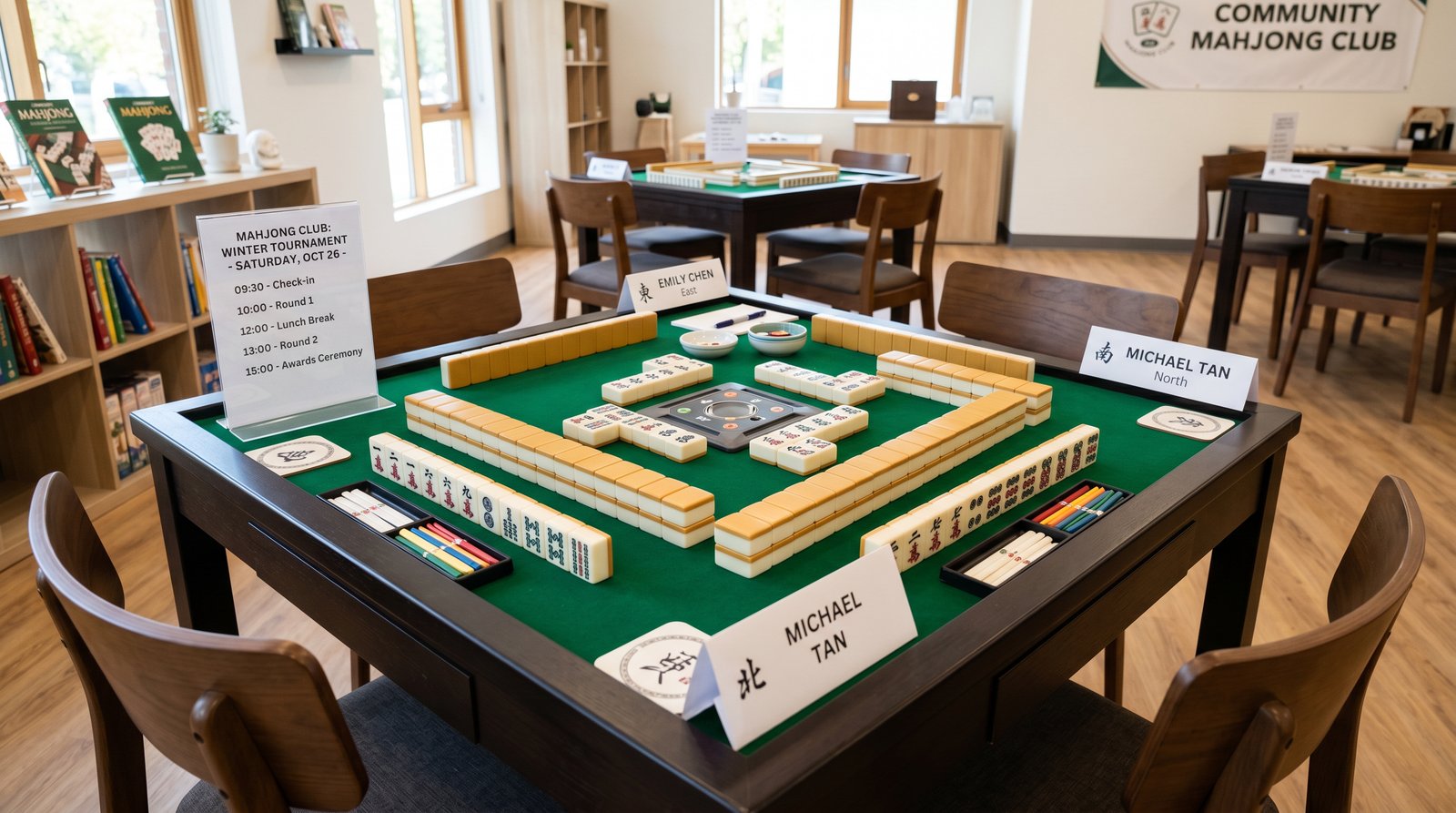
Rotating seating assignments is the single most effective tool here. Randomize tables at the start of each session, or at minimum rotate assignments month to month. Put name cards out (see the photo above for the idea). Make it a house norm that everyone plays with different people, not a punishment. When players know everyone at the club, they stay. When they only know their four friends, they leave if those friends leave.
4. You're Doing Everything Yourself (And It Shows)
Running a club solo is a trap that catches almost every organizer eventually. You handle the group texts, track who paid dues, manage the waitlist, greet new players, resolve the scoring dispute at table two, and somehow still try to actually play a game. After a few months of this, you start dreading Thursdays. And your players can feel it.
Organizer burnout has a direct effect on club culture. When the person running things is stretched thin, follow-through suffers. The email about next week's schedule goes out late, or not at all. The new player who emailed about joining gets a response four days later. The member who hasn't shown up in three weeks gets no check-in. These small gaps accumulate into a club that feels disorganized, and players who are on the fence start finding other things to do.
The solution is delegation and, where possible, automation. Create a simple role for a co-organizer or "table captain" who helps seat players and onboard newcomers. Use tools that handle confirmations, reminders, and waitlist management automatically rather than by hand. Handle dues collection through a system with a clear process rather than chasing cash at the table (our guide on how to collect mahjong club dues covers this in detail). The point is not to make the club run like a corporation. The point is to make it run without you having to hold every thread simultaneously.
5. No-Shows Create a Chain Reaction
One no-show at a four-person table means that table either plays three-handed or dissolves entirely. Three-handed NMJL is a workable fix, but it's not what anyone signed up for. When it happens repeatedly, the players who showed up on time start questioning whether the club is worth the effort.
The downstream effects compound quickly. A regular who arrives to find a half-empty table leaves earlier than planned. Next week, she's a little less certain she'll come. The week after that, she has a conflict and decides not to make the effort to reschedule. A pattern that started with one missing player has quietly turned into two.
This problem has a mechanical solution: RSVP systems with automatic reminders and waitlists that fill open spots. Clubs with automated pre-event reminders see no-show rates drop significantly, and waitlisted players who get notified of an opening show up at high rates because they were already motivated.
The behavioral side matters too. Set an explicit expectation that members update their RSVP as soon as they know they can't make it. Not an hour before. Not a text to the group chat hoping someone sees it. A direct cancellation through whatever system you use, giving the next person on the waitlist time to show up. For more on managing this specific failure mode, see our post on the seven sub request mistakes that kill your club roster.
6. Nobody Notices When They're Gone
This is the quietest and most damaging retention failure of all. A player misses one week, then two, then stops showing up entirely. Nobody reaches out. She assumes nobody noticed, because nobody said anything. By the time you wonder where she went, it's been six weeks and the trail is cold.
A 2025 iMIS membership benchmark report found that 46% of members who don't renew cite "lack of engagement" as the primary reason. Not cost. Not scheduling conflicts. Lack of engagement, which is another way of saying: I didn't feel like anyone would miss me.
Research published in NCBI (PMC12061696) confirms what many instructors already know intuitively: social interaction and a sense of connection are the primary mechanisms through which regular group activities like mahjong improve wellbeing. Players aren't just coming for the tiles. They're coming to feel part of something. When that feeling is absent, the tiles alone aren't enough to keep them.
The intervention is simple and takes five minutes. Keep a basic attendance log, even a spreadsheet. When someone misses two weeks in a row, reach out personally: not a mass club email, a direct message. "Hey, missed you Thursday, everything okay?" That single touchpoint recovers a significant share of players who were drifting rather than actively deciding to leave. The ones who are done for other reasons will appreciate being asked anyway. Either outcome is better than silence.
The Retention Checklist
Use this as a monthly audit for your club:
Onboarding
- Every new player is greeted by name and assigned a buddy for their first two sessions
- House rules and pace-of-play expectations are shared before the first visit
- A follow-up message is sent after each new player's first session
Schedule
- Session dates, times, and locations are posted at least two weeks in advance
- Holiday schedule changes are communicated a full month ahead
- Cancellations include a makeup plan or next-date confirmation
Table Culture
- Seating assignments are rotated regularly (weekly or monthly)
- New players are placed with patient regulars for their first sessions
- Table dynamics issues (pace mismatches, tension) are addressed privately
Operations
- Dues collection has a clear, consistent process that doesn't rely on cash at the door
- A co-organizer or table captain shares the hosting load
- Waitlist management is automated or handled consistently
Attendance
- RSVPs are required and members know the cancellation expectation
- Automated or manual reminders go out 24 to 48 hours before each session
- No-show patterns are tracked and addressed
Follow-Up
- Attendance is logged each session
- Players absent two or more weeks in a row receive a personal check-in
- Lapsed members (four or more weeks out) get a direct re-engagement message
Fixing these six areas won't solve every challenge your club faces. But they address the specific, predictable reasons players leave, and most of them are fixable without spending money or adding significant time to your week.
If you're ready to handle scheduling, RSVPs, waitlists, dues, and attendance tracking in one place designed specifically for American Mahjong clubs, book a demo with Mahjician. We built it for instructors and club operators who want to run a tighter ship without turning club night into a second job.
And if you're heading into card-drop season and want to turn new curiosity into long-term players, our post on turning the NMJL card drop into your biggest recruiting month walks through the timing.
The players are out there. Hold on to the ones you have.