How to Run a Mahjong Program at Your Community Center
A mahjong program requires minimal equipment, attracts loyal members who renew, and carries peer-reviewed cognitive health benefits you can cite at your next board presentation. This guide covers everything from hiring instructors to tracking the numbers that prove the program is working.
By Trey Peirce
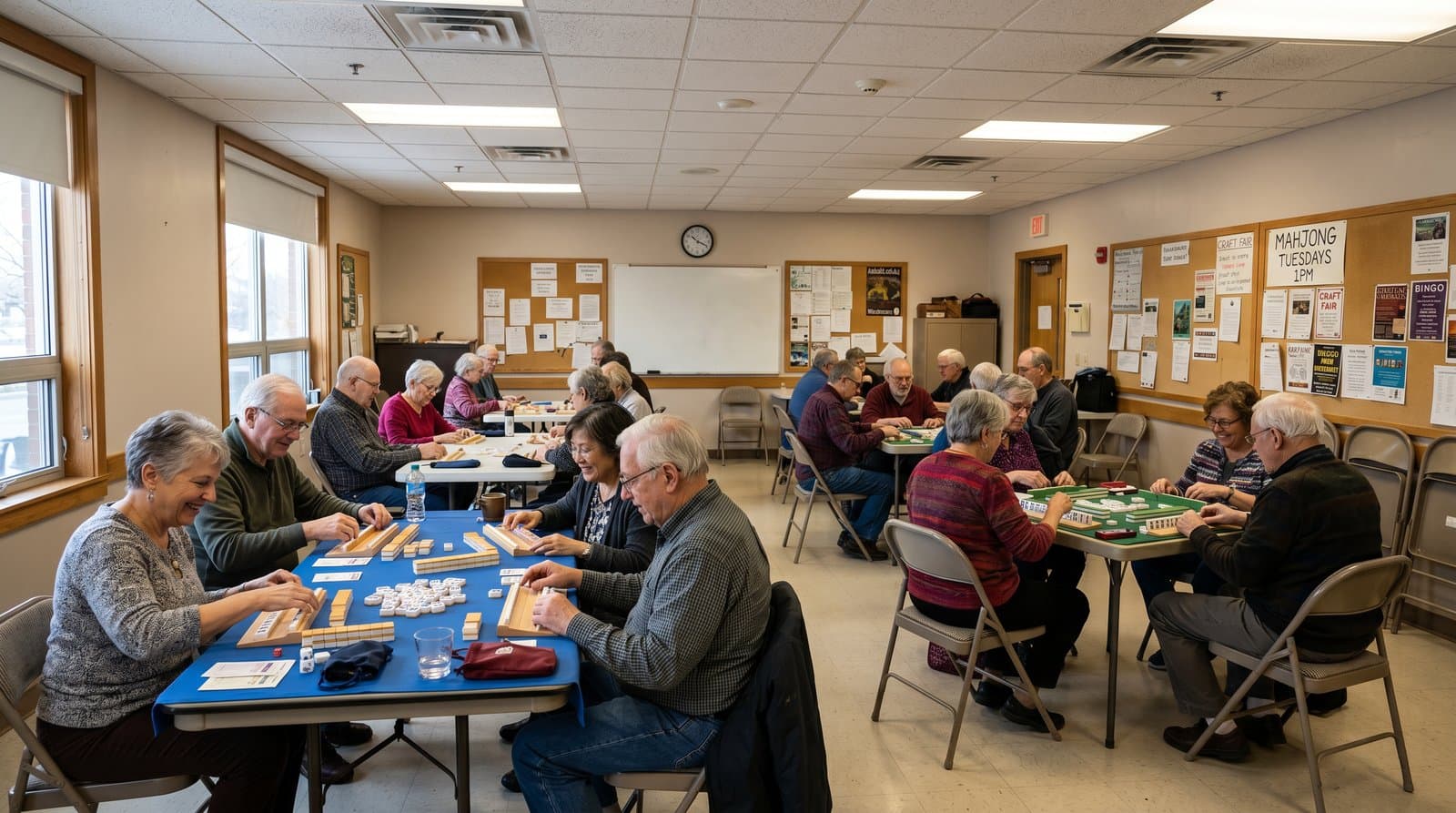
A mahjong program is one of the highest-ROI activities you can add to a community center calendar. It requires minimal equipment, attracts a loyal demographic that renews memberships season after season, and has peer-reviewed cognitive health benefits you can cite in your next board presentation. Whether you coordinate programming at a JCC, a parks and recreation department, or a senior living community, this guide gives you the operational framework to launch, price, staff, and sustain a mahjong program that keeps your attendance reports looking strong.
TL;DR: Start with a structured beginner course (five to six sessions), hire or contract a certified instructor, price your sessions in line with comparable JCC programs ($145 to $165 per member per series), convert graduates to a weekly open play session, and track three numbers: enrollment, retention rate, and revenue per square foot of room usage.
Why Mahjong Belongs on Your Program Calendar
Before you pitch this to your board or your supervisor, you need the business case and the health case. Fortunately, both are strong.
The business case. American Mahjong is one of the few activities that fills seats repeatedly without significant capital investment. You need square tables (36 to 38 inches is ideal), tile sets at roughly one per four players, and a few sets of the current-year National Mah Jongg League (NMJL) card. A starter kit for four tables runs under $400. Compare that to a fitness class requiring equipment replacement, or a pool program requiring lifeguard certification.
More importantly, mahjong participants are sticky. Real programs confirm this pattern: the JCC of Middlesex County in Edison, New Jersey runs open play twice weekly (Tuesdays at 3 PM and Thursdays at 1 PM) as a free member benefit, and participation is self-sustaining. JCC Rockland in New York runs structured beginner and advanced-beginner courses at $145 for members and $165 for the public per five-session series, with multiple sections per season. These are not one-off workshops. They generate recurring enrollment every quarter.
The health case. This is the slide your board actually wants to see. A 2024 scoping review published in the Journal of Prevention of Alzheimer's Disease examined 53 studies across Western and Asian databases and found that more mahjong-playing experience was associated with better cognitive, psychological, and functional abilities in older adults. As an intervention, playing mahjong was found to enhance general cognitive abilities and short-term memory and to relieve depressive symptoms (Tse et al., 2024).
A separate 2024 longitudinal study published in Frontiers in Public Health tracked older adults from 2008 to 2018 using the Mini-Mental State Examination (MMSE) and found that mahjong players maintained stable cognitive scores across all four measurement waves while non-players showed significant decline (Zhu et al., 2024). The study identified improved reaction time, attention, calculation, and self-coordination as specific cognitive domains linked to regular mahjong play.
You can present these findings with confidence. They come from peer-reviewed, indexed journals. When a board member asks why you are allocating a room to tile games on Tuesday afternoons, you have a citation-backed answer.
Step 1: Find and Vet Your Instructor
Your program's reputation depends on your first instructor hire. A bad experience in the first beginner series will empty your roster faster than any scheduling conflict.
What to look for. For American Mahjong, you want someone who plays by NMJL rules and holds a current NMJL card. Many instructors are certified through guilds such as the Mahjong Teachers Guild or similar regional bodies. A listing on a directory like MahLife.com or a recommendation from NMJL.org is a good starting signal. Ask candidates how they handle beginners who learn at different speeds, since a class of eight will always have a range of prior experience.
Contractor vs. staff. Most community centers start with a contract instructor paid per session or per series. A typical arrangement is 60 to 70 percent of session revenue to the instructor, with the center retaining the balance for room costs, administration, and equipment. Some JCCs fold the instructor cost into a flat programming fee and pay a set rate per series. Either model works; what matters is that the arrangement is documented and that the instructor understands the center's cancellation and substitute policy before the first session runs. For a deeper look at the instructor relationship, see our post on the sub request mistakes that most commonly damage club rosters.
One instructor or two. A single instructor handles a beginner section of six to eight learners comfortably. If your first series sells out and you open a second section, you will either need a second instructor or a teaching assistant. Plan for this in your initial budget, because a sold-out beginner course is the best problem you can have.
Step 2: Structure Your Beginner Course
The beginner course is the front door of your program. Everything downstream, including ongoing open play, your intermediate cohort, and your annual tournament, flows from how well this course is designed.
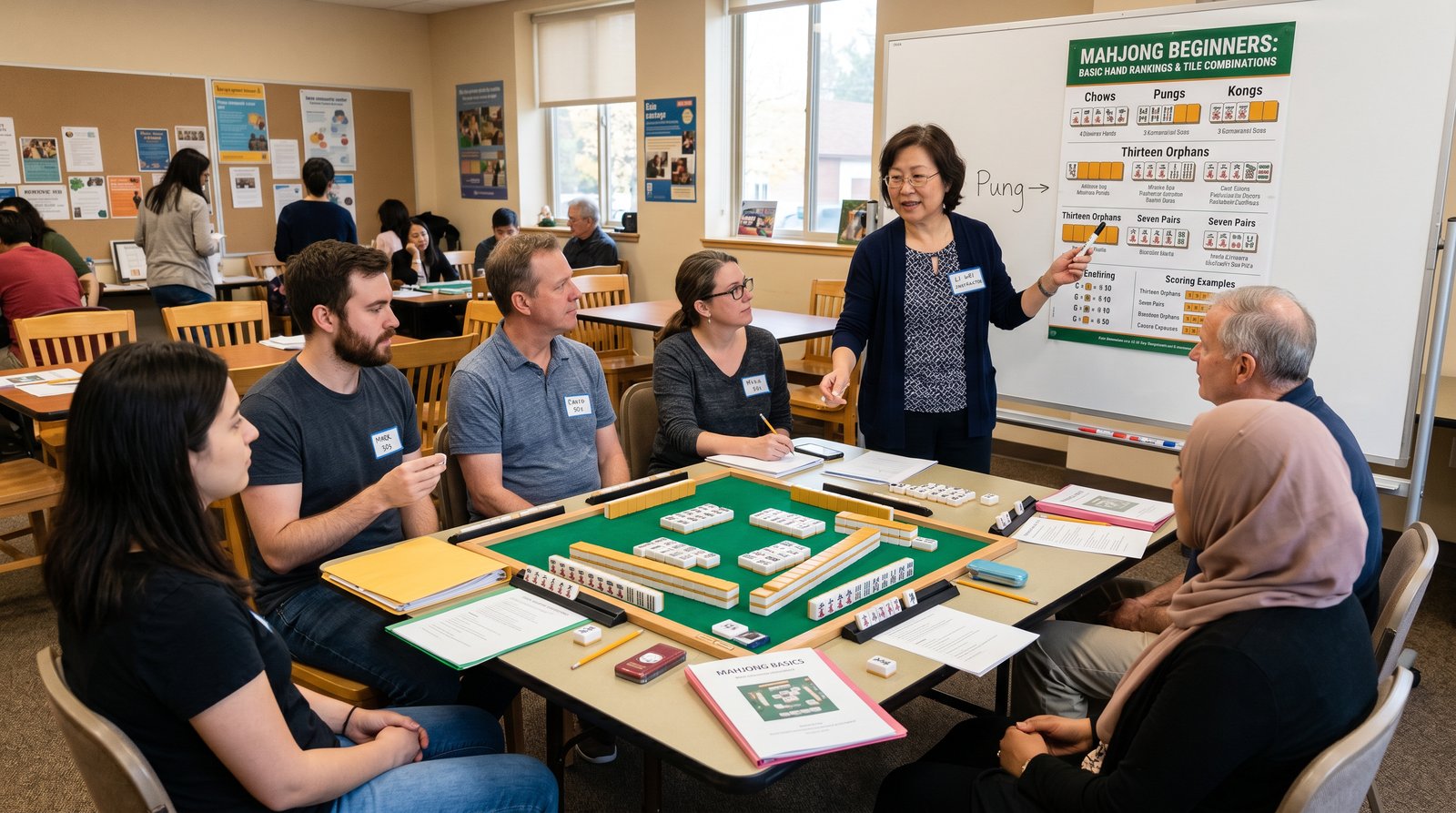
Session count. Five sessions is the practical minimum for American Mahjong. Six sessions gives your instructor room to pace the material without rushing the card reading unit, which is consistently where new players get lost. JCC Rockland's model of five 2-hour Monday sessions is a widely replicated format. Two hours per session, five sessions, works out to 10 hours of instruction, which is enough to produce an independent beginner who can sit at an open play table.
What each session should cover. A sample arc for six sessions:
- Overview of the NMJL card, tile identification, rack setup, dealing and drawing basics
- Reading the card: suits, winds, dragons, jokers, and the hand categories
- Building hands: identifying a workable hand early, understanding calling
- Discarding strategy: what to throw, reading the table
- Full game play with instructor coaching at each table
- Review session: common mistakes, etiquette, and introduction to open play
You can adapt this outline each year when the new NMJL card is released. For a practical guide to transitioning existing groups when the card changes, see our post on teaching the new NMJL card without losing your group.
Class size. Eight to twelve participants is the sweet spot. Fewer than eight and the instructor has trouble filling four-player tables during practice rounds. More than twelve and one instructor cannot give adequate attention. If demand exceeds twelve, open a second section rather than expanding a single section.
Handouts and materials. Provide each participant with a current NMJL card (available from NMJL.org for a nominal fee) and a simple one-page reference sheet covering tile names and joker rules. Do not assume participants will purchase their own cards before the first session.
Step 3: Set Pricing That Reflects Value
Underpricing is the most common mistake coordinators make with mahjong programming, often because they treat it as a casual activity rather than a structured course. Here is what JCC pricing data from programs nationwide looks like in practice.
Instructional series (5 to 6 sessions): $145 to $165 for members, $155 to $175 for the public. JCC Rockland's published pricing for spring 2025 and 2026 sessions sits at $145 members and $165 public for beginner and advanced-beginner mahjong. This is a reliable baseline.
Open play (ongoing, weekly): Most JCCs offer this free to members as a retention benefit. If you charge for open play at a parks and rec center, $5 to $8 per session is common. Some programs sell a seasonal open play pass at $40 to $60 for ten weeks.
Drop-in rate: $15 to $20 per session for non-members attending a beginner course on a trial basis.
The key principle: price your instructional course to cover instructor cost, materials, and a margin for the center, with member pricing serving as a loyalty benefit rather than a loss leader. If a five-session series costs your center $500 in instructor fees and $50 in materials, a class of eight at $145 each generates $1,160 in gross revenue, a healthy return for a room that would otherwise sit empty on a Tuesday morning.
For a detailed pricing framework with breakeven analysis and tiered models, see our post on how to price your mahjong lessons.
Step 4: Run Open Play as a Member Retention Engine
The beginner course graduates players. Open play keeps them. This is the part of the program that directly affects membership renewal, and it deserves more operational attention than most coordinators give it.
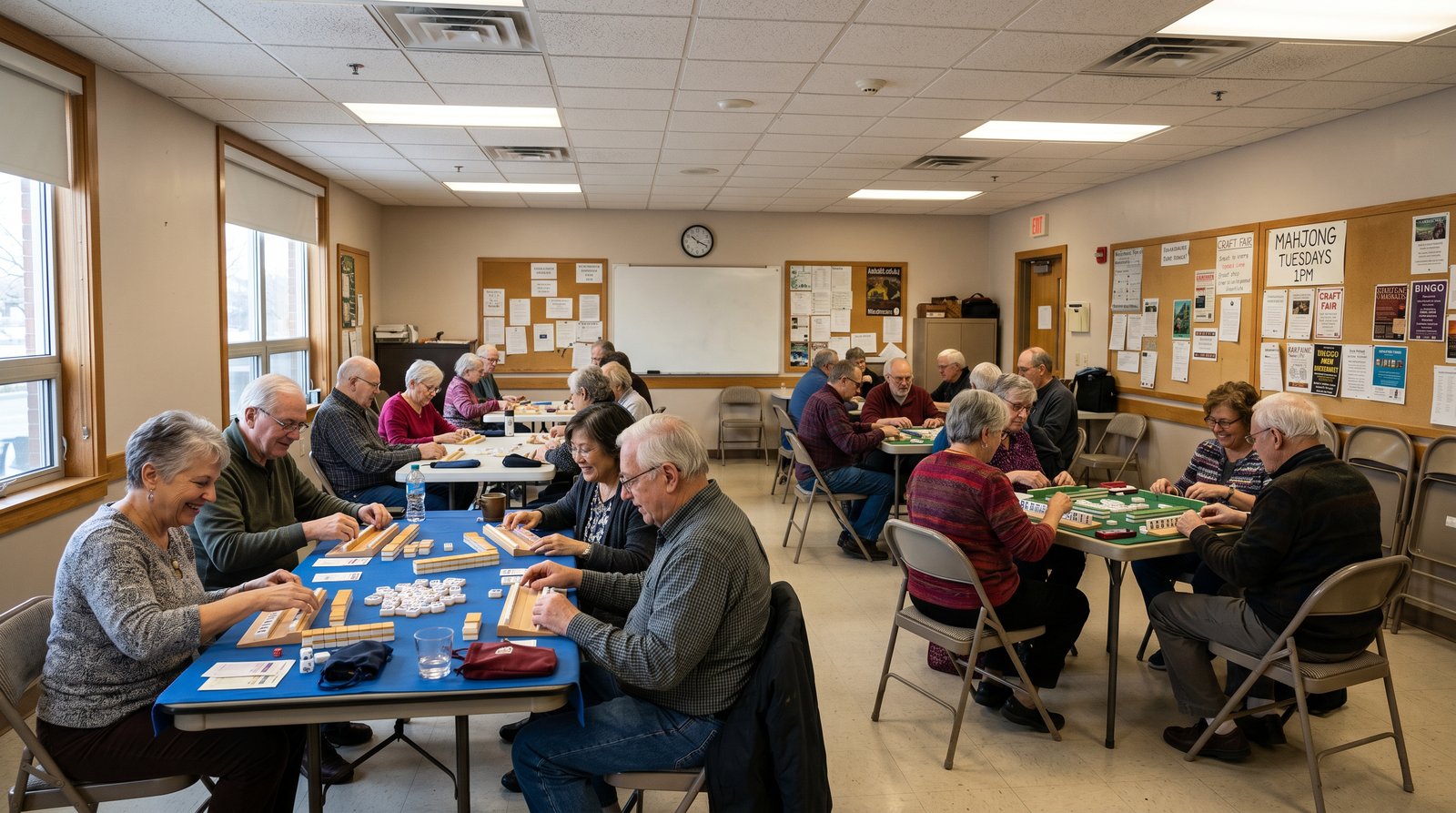
Scheduling. Daytime slots (10 AM to noon, or noon to 2 PM on weekdays) fill reliably for the 55-plus demographic. Evening sessions work for working-age players who are increasingly part of the American Mahjong resurgence, but attendance is more variable. Choose a consistent day and time and protect it aggressively on the facility calendar. One of the clearest findings in senior center programming research is that consistent scheduling drives attendance habits, and habits drive retention. A 2017 NYC Department for the Aging study found that over 70 percent of senior center members maintained or increased their attendance frequency over 12 months, with consistent, accessible programming cited as the primary driver.
Table setup. You need square tables, 36 to 38 inches, with four chairs. Round or rectangular tables are a recurring source of frustration because players cannot reach all tiles comfortably. If your facility uses rectangular folding tables, budget for four to six card tables designated for the mahjong program. Label each table with a number or letter so you can give seating assignments quickly when managing a large open play session. The investment pays back quickly.
Social design. Mahjong open play works best when participants feel like regulars, not visitors. Small touches matter: a consistent room location, name tags for the first few sessions of a new cohort, and a brief welcome back at the start of each session. The 2024 Frontiers in Public Health longitudinal study noted that the social and verbal communication aspects of mahjong contribute to cognitive engagement over time. When participants feel socially connected to the group, they attend more consistently, and consistent attendance is what your board wants to see on the quarterly report.
Managing substitutes and waitlists. At some point your open play session will have 17 people show up for 16 seats. Have a protocol ready: a written waitlist, a substitute notification system, and a clear rotation policy for overflow players. This is an area where program management software makes a real operational difference. A simple spreadsheet with contact information and a group text channel is enough to start, but as the program grows, consider a platform that handles RSVPs and waitlists automatically. For a detailed look at how substitute management affects long-term roster health, see our post on the sub request mistakes that most commonly damage club rosters.
Keeping NMJL cards current. The NMJL releases a new card every year, typically in the spring. Open play participants need the current card. Build a reminder into your program communications each spring, and consider selling cards at your front desk as a convenience for members. For guidance on managing the annual card transition without disrupting your group, see our post on teaching the new NMJL card without losing your group.
Step 5: Build Your Instructor Pipeline
A program that depends on a single instructor is fragile. If your lead instructor takes a vacation, has a health issue, or moves away, your program stalls. Start building redundancy before you need it.
Identify players who teach. After two or three beginner series, you will have graduates who are skilled, consistent, and enthusiastic. Some of them will want to teach. A lead instructor mentorship arrangement, where an experienced player assists during sessions and eventually leads a section independently, is a low-cost way to develop a second instructor without recruiting externally.
Document your curriculum. Ask your lead instructor to write out the session outlines, handout templates, and house rules. This documentation protects the program if personnel change. It also makes it easier to onboard a second instructor who is already certified but unfamiliar with your specific program structure.
Relationship with NMJL. The National Mah Jongg League (NMJL.org) is the governing body for American Mahjong and maintains resources for instructors and club organizers. Staying connected to NMJL resources helps you recruit qualified instructors, access updated materials, and keep your program aligned with the standard that your members already know.
Step 6: Track the Numbers That Matter
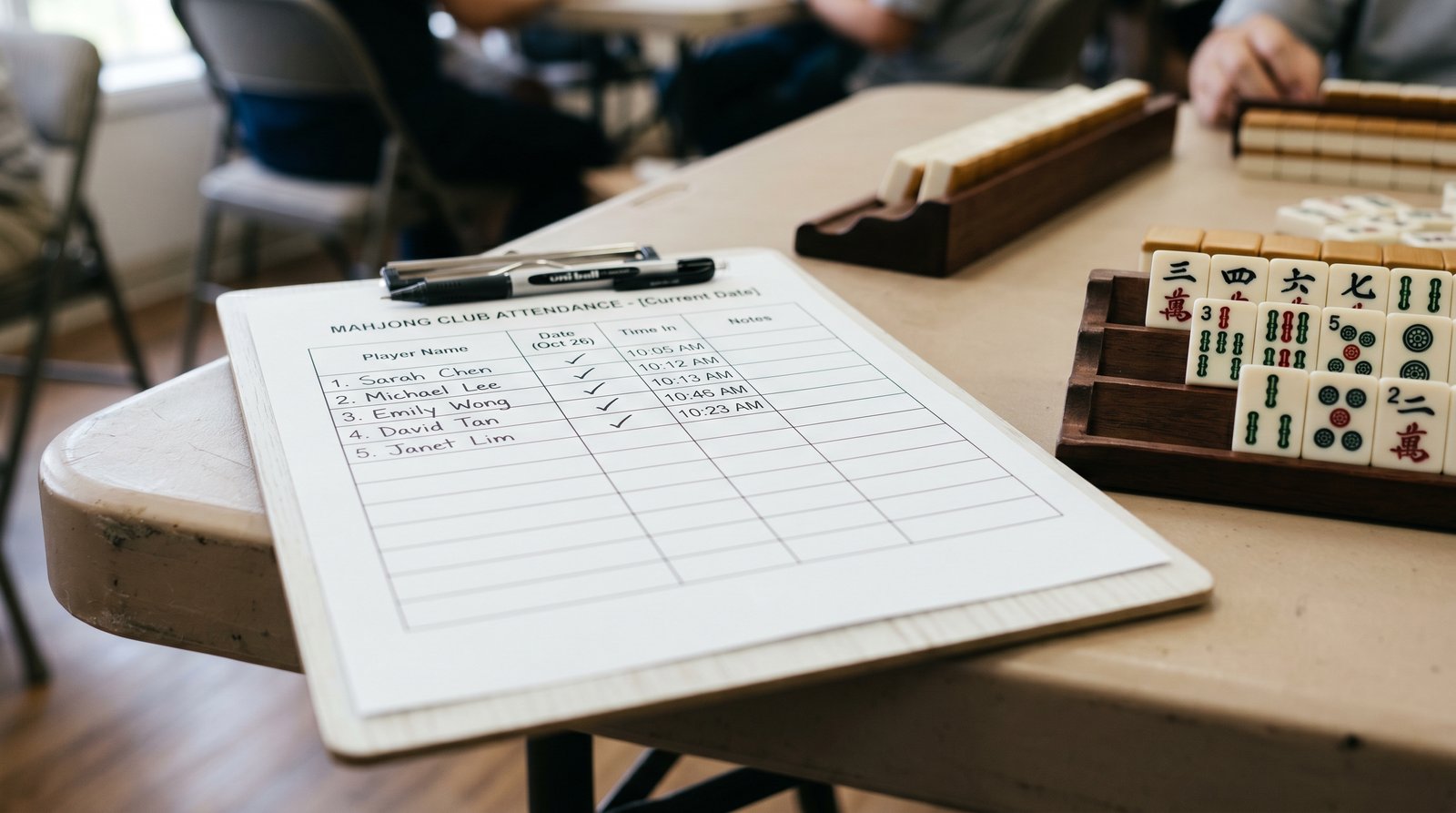
Your program needs to prove its value to the people who approve your budget. Here are the three metrics that matter most for a mahjong program at a community center.
Enrollment rate. What percentage of available seats fill in each beginner series? A program with consistent 80 to 100 percent enrollment in beginner courses is healthy. If you are running at 50 percent or below, you have a marketing or scheduling problem, not a program problem.
Beginner-to-open-play conversion rate. What percentage of beginner course graduates attend at least one open play session within 60 days of completing the course? Healthy programs run 60 to 75 percent conversion. Lower than 50 percent usually indicates that the beginner course and the open play session feel disconnected to participants. Consider scheduling the first open play session immediately after the final class, so graduates have a built-in on-ramp.
Revenue per room-hour. Divide your gross program revenue (tuition collected) by the number of room-hours used (number of sessions multiplied by session length in hours). For a beginner series generating $1,160 across five 2-hour sessions, that is $1,160 divided by 10 hours, or $116 per room-hour. Compare this to other activities using the same room. Mahjong typically outperforms drop-in recreation and many fitness classes on this metric because it requires no equipment from the center beyond tables and chairs.
What to report to your board. A clean quarterly summary should include: total enrollment across all sessions, open play average attendance, revenue collected versus expenses, and any member testimonials you have collected. The cognitive health research is a useful frame for your annual report: you can legitimately say that your mahjong program delivers a socially and cognitively engaging activity supported by peer-reviewed research in leading public health journals.
Common Operational Problems and How to Handle Them
"We can't find an instructor." Start with NMJL.org and Mahjong Teachers Guild directories. Post on local Facebook groups for American Mahjong. Contact your nearest JCC; they may share instructor contact information or be willing to connect you with their program coordinator. Also look inside your existing membership: experienced players often become instructors when asked directly.
"Attendance is inconsistent." The most common cause is inconsistent scheduling. If you moved the session time or room for one or two sessions due to facility conflicts, you have disrupted the habit loop. Protect your mahjong room reservation aggressively on the facility calendar.
"We have too many beginners and not enough tables." This is a good problem. Open a second section of the beginner course before expanding the first section. A well-run section of eight outperforms a crowded section of fourteen every time.
"Our members are playing on different years' cards." Standardize on the current NMJL card for all program sessions and communicate this clearly at registration and in your program description. Members who want to use older cards can play in informal private groups; the center-sponsored program should always reflect the current standard.
For a broader overview of starting a mahjong program from scratch, including the first outreach steps and equipment sourcing, see our post on how to start a mahjong club.
Your Next Step
A mahjong program does not require a large budget, a dedicated room, or specialized staff. It requires a structured plan, a qualified instructor, and the operational discipline to track what is working. The programs that grow from a single beginner section into a year-round calendar fixture are the ones where a coordinator treated the launch with the same rigor they would give any other revenue-generating program.
If you are ready to move from planning to operations, Mahjician gives community center coordinators the tools to manage enrollment, track attendance, handle the annual card transition, and generate the reporting your board needs. See how programs like yours are using Mahjician to run tighter operations with less administrative overhead.
References
Tse, Z.C.K., Cao, Y., Chau, B.K.H., et al. (2024). Does Playing Mahjong Benefit Older Individuals? A Scoping Review. Journal of Prevention of Alzheimer's Disease, 11(5), 1363-1377. https://doi.org/10.14283/jpad.2024.102
Zhu, L., Wang, Y., Wu, Y., Wilson, A., Zhou, H., Li, N., and Wang, Y. (2024). Longitudinal associations between the frequency of playing Mahjong and cognitive functioning among older people in China: evidence from CLHLS, 2008-2018. Frontiers in Public Health, 12, 1352433. https://doi.org/10.3389/fpubh.2024.1352433