
Your First Mahjong Class: A Lesson Plan That Won't Lose the Room
The fastest way to lose a room full of mahjong beginners is to explain everything at once. A three-session arc keeps new players coming back.
By Trey Peirce
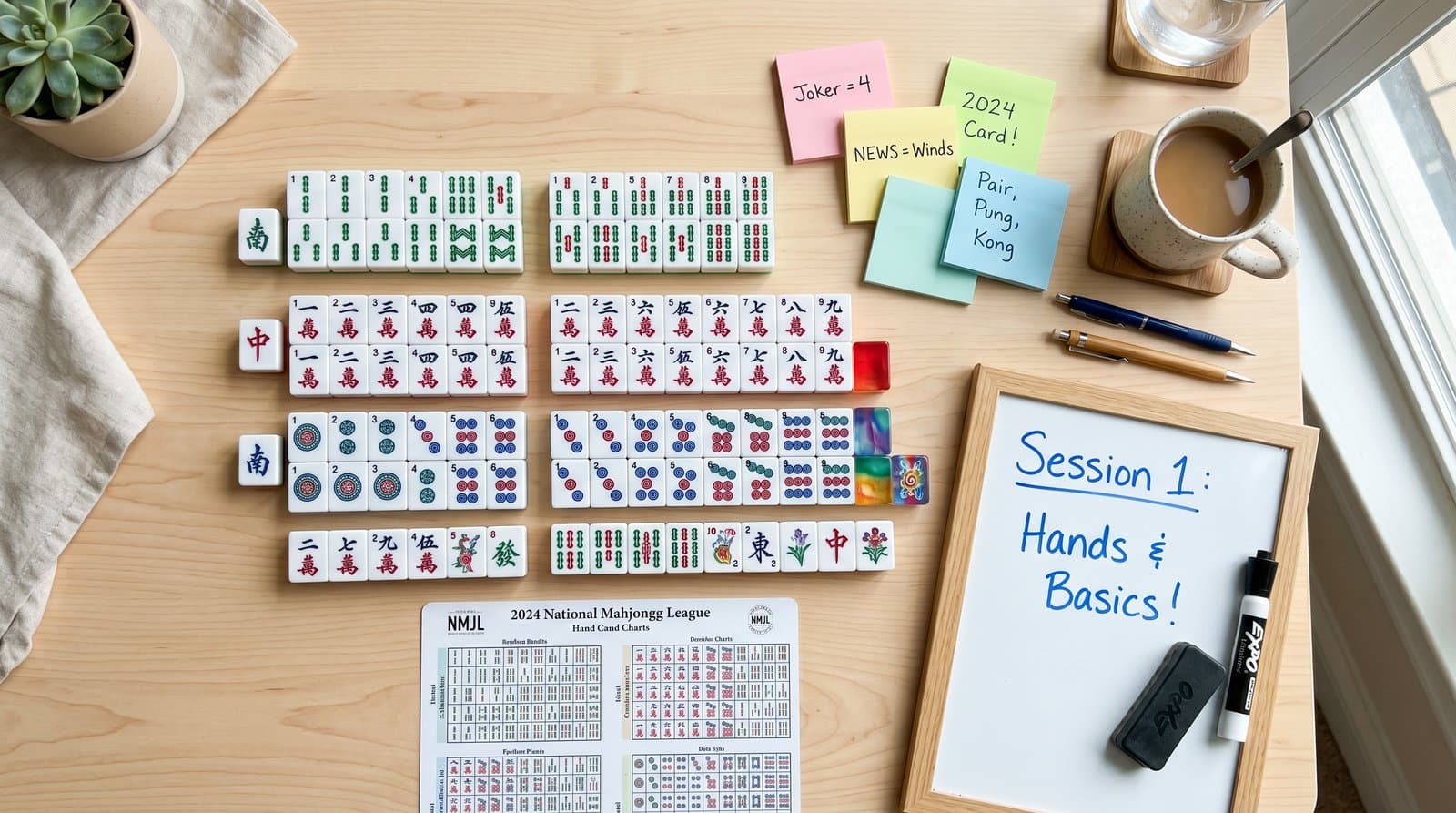
You've got eight women sitting around two tables, zero tile experience between them, and ninety minutes on the clock. The temptation is to cover everything: tile recognition, the wall, the Charleston, the card, scoring, and etiquette, all in one shot so they leave feeling like they got their money's worth.
That's the fastest way to lose the room.
Experienced instructors, including Tom Sloper of sloperama.com (author of The Red Dragon and the West Wind and one of the most cited mahjong educators in the United States) and the team at Mahj Life, consistently land on the same structural insight: new players need muscle memory before complexity. When you try to teach the full game in session one, students don't leave impressed. They leave overwhelmed, they don't practice at home, and they quietly skip week two.
The three-session arc below fixes that. It's the structure that keeps your new players coming back instead of ghosting you after a single class.
What You Need Before Session 1
Pull this together before anyone walks through the door. Scrambling for supplies mid-class breaks momentum and signals to students that the experience isn't organized.
Per table (4 students):
- 1 complete NMJL-legal mahjong set (152 tiles, 4 racks, 4 pushers, 2 dice)
- 1 current NMJL card per student (order in bulk from the National Mah Jongg League)
- Printed one-page tile reference sheet (suits, honors, winds, dragons, flowers, and jokers labeled with images)
- Sticky labels or dry-erase markers for labeling tile suits on racks during session one
- A short printed agenda for each session so students know what to expect
For the room:
- A whiteboard or foam-core board showing the 152-tile breakdown
- A timer you can display (your phone propped up works fine)
- Sign-in sheet collecting name, email, and phone number for your group text
- A small basket with a sample set of accessories from suppliers like Splash of Color Co. or similar, so students can see what nice sets look like and ask questions after class
Digital setup, completed before day one:
- Group text thread already created with your own number as admin
- A shared Google Sheet (or a registration tool like Mahjician) tracking attendance across all three sessions
- Your Venmo or payment link ready if you're collecting per-session fees
If you want a full scheduling framework to wrap around this curriculum, the post on how to build a mahjong schedule that fills every table covers that in detail.
Why One-Session Teaching Fails
The problem isn't that your students aren't smart. It's that mahjong front-loads an unusual amount of unfamiliar vocabulary before a single game moment feels satisfying.
Consider what you're asking a brand-new student to absorb simultaneously if you teach the whole game at once:
- 144 tiles across five categories (bamboo, characters, circles, winds, dragons) plus flowers and jokers
- The physical mechanics of building a wall, rolling dice, and breaking correctly
- The six-pass ritual of the Charleston, including the optional courtesy pass
- How to read 64 hands on an NMJL card and identify which ones you can realistically build
- The cycle of discarding, claiming, and declaring
Each of those is a separate cognitive load. Stack all of them in 90 minutes and your students spend the whole class in a state of managed confusion. They're nodding along, but nothing is sticking. When they get home and try to explain it to their spouse, they can't. That failure of recall kills their confidence, and low confidence is the number-one reason new players don't return.
The School of American Mah Jongg and instructors associated with Missy Mahjong have built structured multi-week curricula around exactly this problem. The pedagogy is consistent: isolate one skill set per session, let it become automatic, then add the next layer.
Three sessions is the minimum viable arc. Some instructors stretch to four or five, especially with older beginners or groups that only meet for an hour at a time. But three works well for 90-minute sessions and keeps the overall course short enough that students commit upfront without hesitation.
Session 1: Tiles and the Big Square
Goal: Every student can identify every tile category, sort a hand by suit, and complete a simplified game before they leave.
Time budget: 90 minutes
Opening (10 minutes)
Start with a clean table. Before you explain anything, have students open the tile set and dump the tiles face-up in the center. Let them look. Let them touch. Let them ask questions. You'll get "Why are there these flower ones?" and "What's the difference between the bamboo one and the bird one?" Those are the exact questions you want, because now you're answering things students are already curious about instead of lecturing into a void.
Tile Recognition (20 minutes)
Walk through the five suit categories in order: bamboo, characters (also called crak or crack), circles (also called bam and dot in some regional traditions), winds, and dragons. Then address flowers and jokers separately.
Use your reference sheet. Have students sort their tiles into piles by suit on the table, not on their racks yet. Sorting by hand, tile by tile, builds tactile familiarity faster than any diagram.
Test comprehension with a quick call-and-response: hold up a tile, have students call out the suit and number. Keep it fast and low-stakes. The goal is fluency, not perfection.
The Big Square (15 minutes)
Before you touch the wall, introduce the Big Square as a sorting technique: tiles organized on the rack by suit from left to right, with like tiles together. This is the physical habit that makes hand-building feel natural. Students who skip this step end up with chaotic racks that slow down their decision-making for months.
Demonstrate on one rack while students mirror you on theirs. Run a few rounds of "deal yourself a hand and sort it into a Big Square" until the motion feels comfortable.
Simplified Play (40 minutes)
Run a simplified game with no wall and no Charleston. Deal 13 tiles per player. Skip jokers for now. Players draw from a central pile, discard face-up, and the first player to build any three sets plus a pair calls "Mahjong" and wins.
This version strips out everything that isn't tile recognition and basic set-building. It's not real NMJL play, and you can say so directly: "This isn't how the full game works, but it's going to train your eyes to see sets fast. We'll add the real rules starting next week."
Give them two full rounds. Circulate the room. Narrate out loud what you're seeing: "She's got three characters there, watch how she's organizing those."
Wrap-Up (5 minutes)
Collect reference sheets to hand back at session two (this nudges attendance). Tell students what session two will cover. Send a group text that evening with a one-sentence recap and a reminder of the next meeting time.
Session 2: The Wall and the Charleston
Goal: Every student can build and break the wall correctly, and complete a full six-pass Charleston without prompting.
Time budget: 90 minutes
Wall Building (25 minutes)
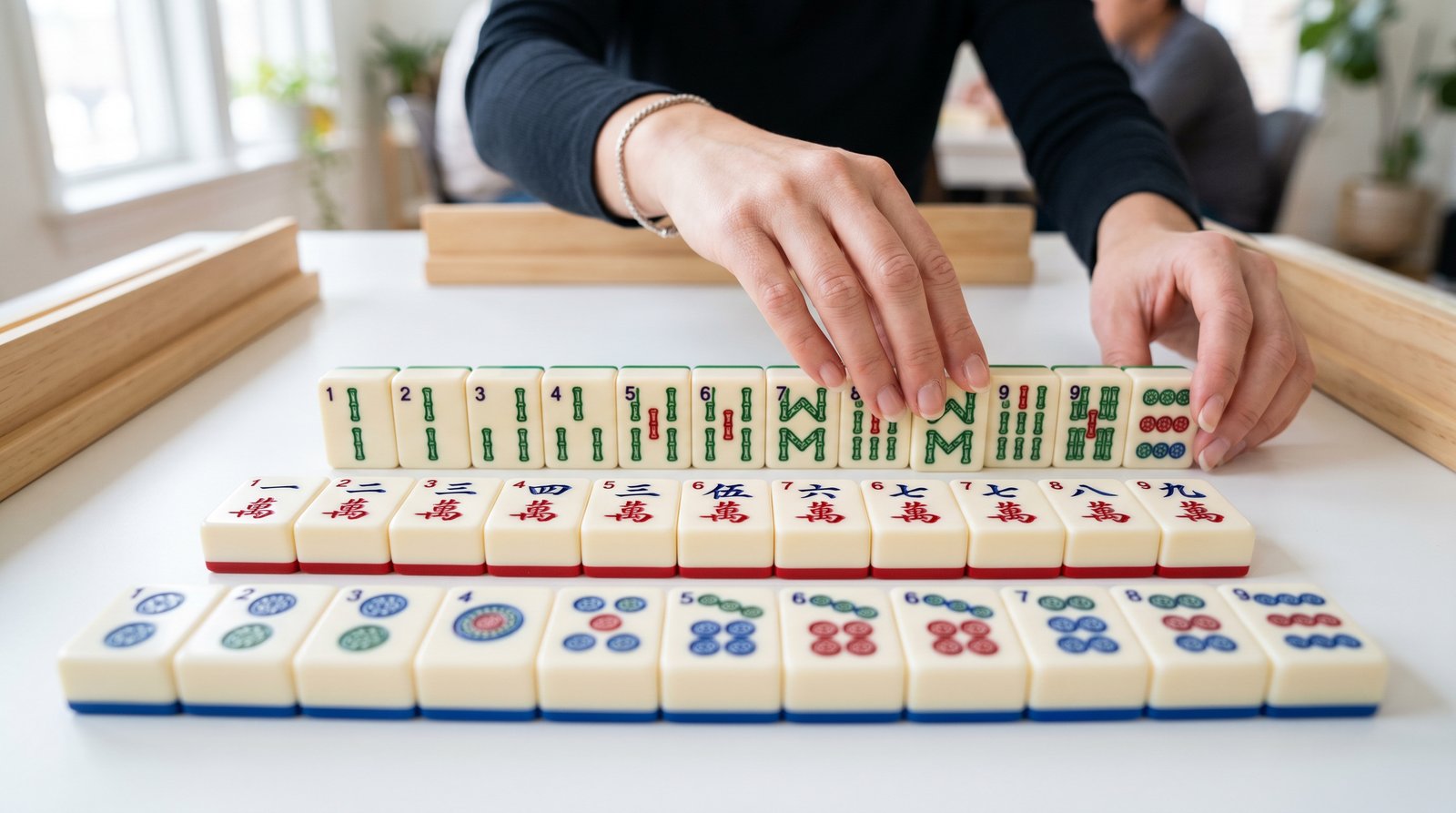
Start by showing a correctly built wall: four sides, each player builds their own section, tiles face-down, stacked two high. Then roll dice and walk through the break: count from the right of the dealer's section, separate at that point, and the dealer draws first.
The most common errors here:
- Students building uneven-length walls (remind them to count tiles before building)
- Students breaking from the wrong end or miscounting after the dice roll
- Confusion about who draws first and in what order
Do three full wall builds before moving on. Have students take turns playing dealer so everyone practices the dice roll and break.
The Charleston: ROLLOR (40 minutes)
The Charleston is where many first-time instructors lose the room, because the pass sequence is genuinely confusing the first time you hear it described verbally.
Use the ROLLOR mnemonic: Right, Over, Left, Left, Over, Right.
Write it on your whiteboard. Have students say it out loud three times before touching a tile.
Then walk through it physically, step by step:
- First Right: Each player passes three tiles face-down to the player on their right.
- First Over: Each player passes three tiles face-down to the player across the table.
- First Left: Each player passes three tiles face-down to the player on their left.
- (Optional blind steal between Left and the second Charleston, if you choose to introduce it here. Many instructors skip this until session three.)
- Second Left: Each player passes three tiles face-down to the player on their left.
- Second Over: Each player passes three tiles face-down to the player across.
- Second Right: Each player passes three tiles face-down to the player on their right.
After the second Charleston, the optional courtesy pass: any player may offer 1, 2, or 3 tiles to an adjacent player, who may accept any or all.
Run a Charleston-only drill with no subsequent play. Deal tiles, run the full sequence, then pause and discuss. "What did you pick up? What did you pass that you regret? Why?" Getting students to narrate their own reasoning aloud accelerates learning faster than more demonstrations.
Then run two full games incorporating the wall and Charleston, using the simplified scoring from session one (no card yet).
Wrap-Up (5 minutes)
Preview session three: "Next week we bring out the card, and everything you've been doing starts to make sense in a new way." That framing builds anticipation. Return the reference sheets.
Session 3: The NMJL Card
Goal: Every student can read a hand on the card, identify at least three hands they want to build, and complete a full NMJL-style game.
Time budget: 90 minutes
Reading the Card (20 minutes)
Give each student a current NMJL card. Walk through the notation system: F (flower), D (dragon), the suit abbreviations, the number notation, and the value markers on the right side of each hand.
Focus on two concepts first:
- Closed vs. open hands. A hand marked with a line at the start cannot use tiles claimed from discards. Students need this so they don't inadvertently expose a closed hand by reaching for a discard.
- Same-suit vs. any-suit hands. Hands that require all tiles of one color versus hands that can mix suits look visually similar but play very differently. Run a few examples until students can spot the difference at a glance.
Have each student circle three hands on their card that they find appealing. This personalizes the card immediately and makes it feel like a toolset rather than a rulebook.
Hand-Choosing Strategy (15 minutes)
Walk through how experienced players approach the Charleston with a target hand in mind. Resources like NMJL Made Easy and the instruction materials from Southern Sparrow both emphasize this: you want to enter the Charleston with two or three potential hands in mind, not one. Flexibility in the first few passes is what separates players who regularly win from those who spend the whole game chasing a hand they can't build.
This is also a good moment to introduce jokers: what they substitute for, the rule that jokers cannot be used in pairs, and how joker-heavy hands appear on the card.
Full Game Play (45 minutes)
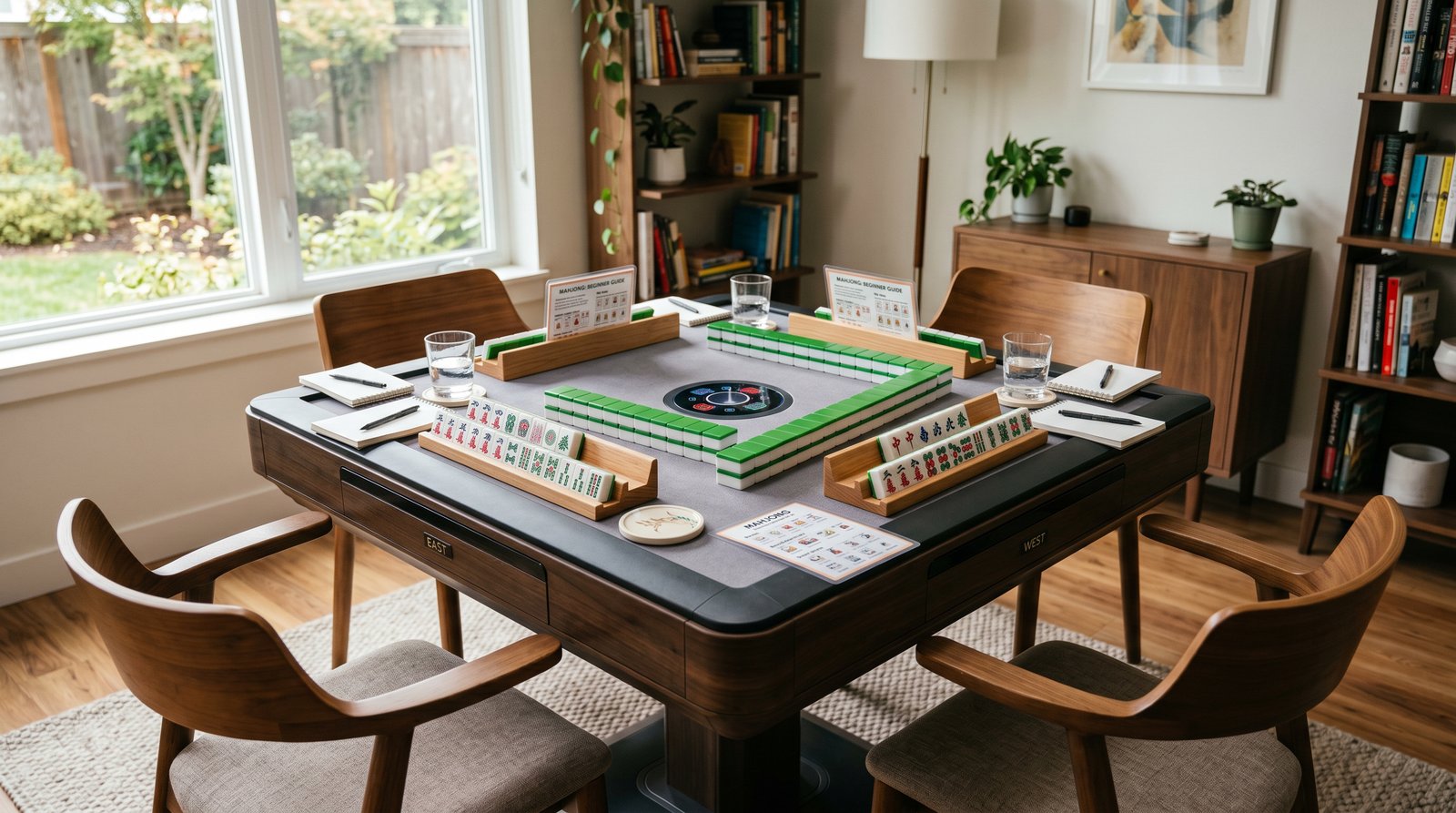
Run a full NMJL game: wall, Charleston, card-based hand-building, claiming discards, calling Mahjong. Circulate and coach. Let students make mistakes. Resist the urge to correct every error in real time; note them and address patterns in the debrief.
Run at least two full games. In the second game, step back further and let the tables manage themselves. You're training independence, not dependence on the instructor.
Wrap-Up and Next Steps (10 minutes)
This is the close. Tell them what comes next: your ongoing weekly session, your club group text, or a recommendation to check out I Love Mahj for community and hand-discussion forums between classes.
If you're affiliated with an organized program, mention it here. Some instructors connected to the School of American Mah Jongg framework use session three as a natural handoff point into their ongoing club structure.
Give students a clear action: "Here's how you sign up for the next session. Here's the group text. Here's where to buy a set if you want to practice at home." Specific, not vague.
5 Common Mistakes Instructors Make
1. Teaching the card in session one. Even if a student asks "But how do we know what hands to build?", redirect. The card without muscle memory is just noise. Defer it.
2. Skipping the simplified game. Some instructors feel the simplified no-card version is "fake" and want to teach the real game from minute one. This almost always results in a slower first session, not a faster one. The simplified game builds the physical habits. Build the habits first.
3. Running the Charleston with too many caveats. The optional blind steal, the courtesy pass rules, the nuances of when you can or can't stop the second Charleston: save the edge cases for session three or beyond. Teach the clean version first.
4. Not collecting contact info at session one. If you don't have emails and phone numbers before students leave the first session, you have no reliable way to remind them about session two. Attendance drops sharply for students you can only reach through social media.
5. Underestimating setup time. New instructors consistently underestimate how long it takes to distribute materials, get tables seated, and quiet the room. Build ten minutes of buffer into your session one plan. You'll use it.
Post-Course Retention: Turning Students into Club Members
The three-session arc is a funnel. Your goal isn't just to teach mahjong; it's to add students to your regular weekly session roster. The conversion from "took the class" to "shows up every week" is where your business model actually works.
A few things that move the needle:
End every session with a clear next step. Not "stay in touch," but "here's the link to register for next Tuesday's drop-in." The friction of finding out what comes next is enough to lose half your conversions.
Create a separate group text for graduates. When students finish the three-session arc, move them to a "regular players" group text. This signals that they've leveled up and belong to an ongoing community, not just a beginner class.
Invite one or two strong graduates to become informal table captains. Ask them to help new beginners during the first few open-play sessions. This flatters the graduate, reduces your coaching load, and creates peer-to-peer teaching relationships that make your club stickier.
Share resources for self-directed practice. Point students toward forums and communities where they can ask questions between sessions: I Love Mahj has active hand-discussion threads, and the Missy Mahjong platform offers structured online follow-up instruction for players who want to go deeper faster.
For more on keeping your roster full, the post on how to recruit new mahjong players covers both digital and word-of-mouth strategies that instructors are using right now.
If you want to think through pricing for this kind of three-session arc, see the breakdown at how to price your mahjong lessons.
Frequently Asked Questions
How long does it take to teach someone mahjong from scratch?
Most students can play a functional game of NMJL mahjong after three 90-minute sessions, assuming each session covers the arc described above. "Functional" means they understand the Charleston, can read the card well enough to choose a hand, and can complete a game without instructor intervention. Proficiency, meaning consistent strategic play and fast card reading, takes several months of regular play.
Do I need a full NMJL card for session one?
No. Introducing the card in session one adds cognitive load that slows down tile recognition. Use a simplified reference sheet in sessions one and two. Save the card for session three.
How many students can one instructor handle per session?
Most instructors working without a co-teacher can effectively manage two tables (eight students) in a teaching session. At three tables (twelve students), you'll spend so much time circulating that students at any given table go too long without feedback. If you're regularly teaching more than eight, recruit a second instructor or promote an advanced student to table captain.
What's the right NMJL card to use?
Use the current year's card. The NMJL releases a new card each spring. Teaching with a prior-year card creates confusion when students start playing with others who have the current card. Order enough copies for every student plus a few extras before session three.
Should I charge per session or as a package?
Most instructors find that package pricing (all three sessions sold as a unit) reduces no-show rates and simplifies the financial conversation. Per-session pricing creates uncertainty: students weigh whether to "skip this week" more often when each session is a separate purchase decision. A flat fee for the full arc, collected before session one, removes that friction. See the detailed breakdown in the post on how to price your mahjong lessons.
If you're running this three-session arc and want the scheduling, registration, and payment side to run without a spreadsheet, you can book 30 minutes with us at mahjician.com.