
How to Recruit New Mahjong Players (6 Tactics That Work)
The best mahjong clubs grow through local community channels, not paid ads. Here are six tactics that consistently fill tables: Facebook groups, library partnerships, personal referrals, Meetup and Eventbrite listings, quarterly learn-to-play workshops, and a simple web presence.
By Trey Peirce

If you run a mahjong club and you need more players, here is the short answer: post in local Facebook groups, partner with your library or community center for a free intro night, ask your regulars to bring one friend, and list your sessions on Meetup and Eventbrite. Those four moves alone will bring most clubs from a wait-and-hope posture to a steady pipeline. Add a quarterly "learn to play" workshop and a basic web presence and you will rarely scramble for players again.
The interest is there. Eventbrite reported a 365% increase in mahjong-related searches between 2023 and 2024, and Yelp tracked a 4,500% surge in "mahjong club" searches over the same period. Your next ten members are already looking. The question is whether they can find you.
Most organizers I talk to discover that one or two channels drive about 80% of their new players. Run the tactics below, track where people heard about you, and double down on what works for your market.

1. Post in Local Facebook Mahjong Groups
Facebook is still the heart of the American Mahjong community. Search for groups like "Mahjong [Your City]," "Mah Jongg Players [Your State]," or "NMJL Players [Region]." Most of these groups have thousands of members who are already playing or actively looking for a club.
What to post: a short, specific message. "We play NMJL every Thursday at 7pm at the Riverside Community Center. Beginners welcome. Message me or register at [your link]." That is it. No long sales pitch. The specifics (day, time, location, skill level) are what people need to decide.
A few tips that make these posts convert better:
- Post at the start of the week, not Friday. People plan for next week on Monday and Tuesday.
- Add one photo from a real game night. A real photo of real people at a real table beats any graphic.
- Respond to every comment within a few hours. Interest evaporates fast.
- Repost every four to six weeks. Members forget or miss posts the first time.
Nextdoor is an underrated second channel here. Mahjong posts on Nextdoor consistently get enthusiastic responses from neighbors who have been wanting to play but did not know a local club existed.
2. Partner with Libraries and Community Centers
Libraries and community centers are looking for programming. You are looking for players. This is one of the cleanest partnerships available to a club organizer.
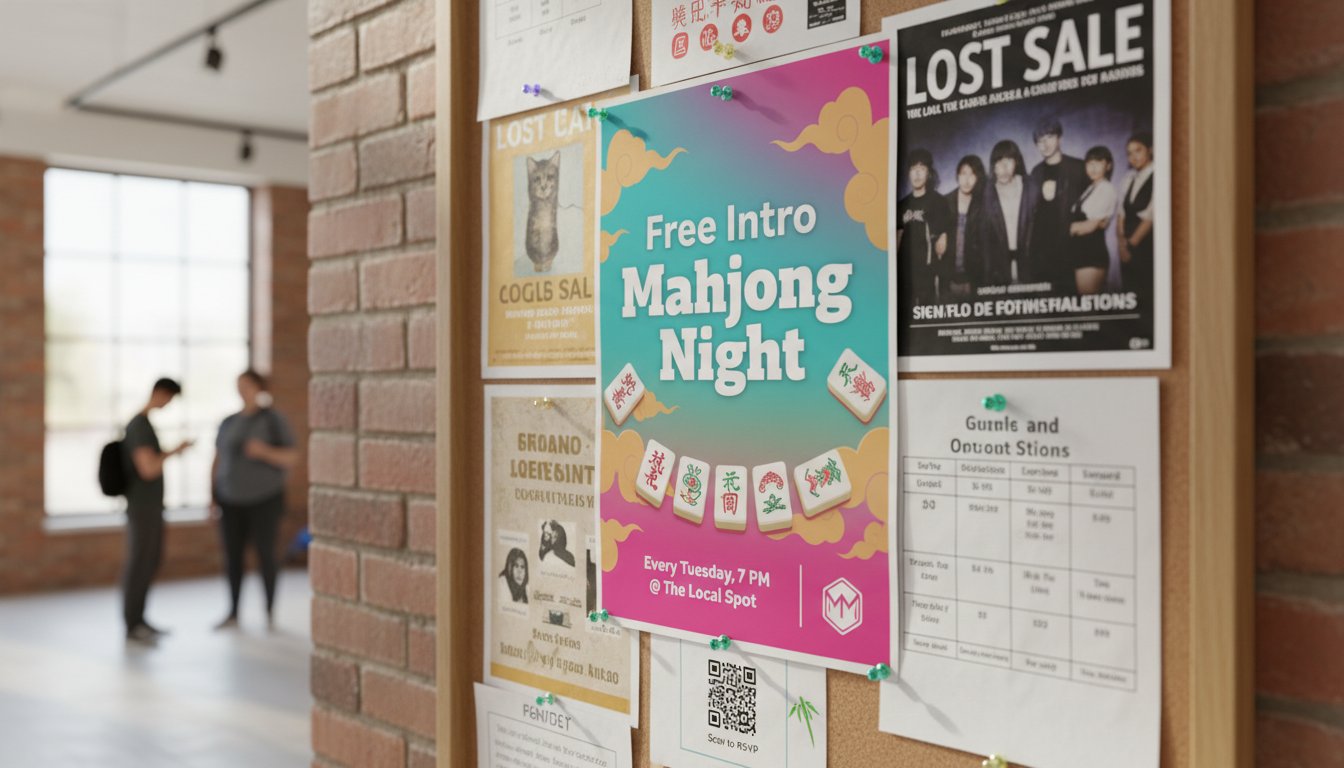
The pitch to a librarian or recreation coordinator is simple: "I would like to host a free mahjong introduction night here. You get an engaging program for your community; I get a room and foot traffic." Most will say yes. Libraries regularly host game nights, hobby meetups, and skill-share events. A mahjong intro fits that programming perfectly.
According to NRPA research, 29% of non-participants in community programs say the main reason they do not attend is that they did not know the program existed. A co-hosted event with the library puts your club in front of people who are already walking through those doors and who are already predisposed to community programming.
Practical notes for these partnerships:
- Offer to handle all logistics. Bring tiles, cards, and handouts. Make it zero work for the venue.
- Ask the library or center to include the event in their own newsletter and social calendar. That distribution is the real prize.
- Plan for beginners only. Set the expectation that this is a first-touch introduction, not a regular game night.
- Follow up within 24 hours. Send every attendee a direct message or email with your next session details. Warm leads go cold fast.
A note on timing: the first visit is the critical moment. A new player who walks into a room of strangers and is not greeted warmly will not come back. Assign someone on your team, or identify a natural greeter among your regulars, to be the official welcome person for these co-hosted events. That one role, handled well, doubles your retention rate from these nights.
For a deeper look at how to structure club logistics once players start joining, see how to start a mahjong club.
3. Ask Current Players for Personal Referrals
Personal referrals are the highest-conversion recruiting channel in almost every service business, and mahjong clubs are no exception. A player who shows up because a friend invited them is already three steps ahead of a cold lead: they have social accountability, they have someone to sit with, and they came expecting to enjoy themselves.
The problem is that most organizers wait for referrals to happen organically. They rarely do, at least not at scale. The simple fix: ask.
After a good game night, say to your regulars: "If you know anyone who has ever mentioned wanting to try mahjong, bring them next week. One person is all I need." That specific ask, given at the right moment (the end of a fun session), converts far better than a general "spread the word."
Make it easy for them to follow through:
- Have a shareable link ready. A registration page or a simple event listing they can forward is far more compelling than "text me if you want to come."
- Give them the language. Some people want to invite friends but do not know what to say. Try: "I go to this mahjong club on Thursdays. The organizer is great and they are teaching new people. Want to try it with me?"
- Acknowledge referrals publicly. A quick "welcome, and thanks to Maria for bringing you" at the table costs nothing and reinforces the behavior you want.
One player who becomes two, who each bring one more, is how clubs go from eight players to a waitlist inside a year.
4. List Your Sessions on Meetup and Eventbrite
Meetup and Eventbrite are discovery platforms. People open those apps specifically looking for things to do. When someone searches "mahjong" or "game night" in your city, your listing is what appears.
Meetup runs about $30 per month for organizers, which feels steep until you realize that one new regular player who pays a session fee each week pays for six months of Meetup in a single month. Eventbrite has free tiers for free events. Either way, the math almost always works.
What makes a listing convert:
- Put the day, time, and address in the title or the first sentence. Do not make people hunt for logistics.
- Use plain language. "Beginner-friendly American Mahjong every Thursday" tells the story. Skip the SEO stuffing.
- Upload a real photo of your group.
- Add "beginners welcome" explicitly. Many potential players self-select out before they even read the description because they assume they are not experienced enough.
Eventbrite's own data shows mahjong-related searches up 365% nationally in 2024 and 867% in some cities like Houston. That search volume is not going to your listing if you are not listed. This is table-stakes visibility.
For a framework on keeping those tables consistently full once players find you, how to build a mahjong schedule that fills every table is a practical next read.
5. Run a Free "Learn to Play" Workshop Every Quarter
A quarterly beginner workshop is the most reliable single-event pipeline builder for most clubs. It serves a specific function: it lowers the barrier for people who are curious but intimidated.
The intimidation is real. American Mahjong has 152 tiles, an annual card with complex hand patterns, and terminology that sounds like a foreign language to someone who has never played. People who would happily try a casual game night will hesitate if they think they will slow everyone down or embarrass themselves. A workshop dedicated to beginners removes that fear entirely.
Structure that works:
- Keep it to 90 minutes. Long enough to play a partial game; short enough not to overwhelm.
- Teach by doing, not lecturing. Get tiles in hands within the first ten minutes.
- Tell people up front: "It usually clicks around the third session. Tonight is session one."
- Have your most patient regulars help. Identify the natural teachers in your group and station them at beginner tables.
- End with a clear next step: your next regular session date and a registration link.
Run it at the library or community center (see tactic two above) and you have built-in promotion from both channels at once.
A few things that will make your workshop more memorable than a standard game night:
- Provide a simple one-page handout with tile categories and a quick reference for the top five hands on the current NMJL card. People love having something to take home.
- Label tiles with stickers or use a teaching set if you have one. Anything that reduces the cognitive load in the first hour helps beginners stay engaged instead of shutting down.
- Take a group photo at the end and post it to your Facebook group or Nextdoor. That photo is its own recruitment post for the next workshop.
On the scheduling side, the NMJL card drop is one of the best natural recruitment hooks of the year. See how to turn the NMJL card drop into your biggest recruiting month for how to time a workshop around that moment.

6. Make Your Club Easy to Find Online
This one is not glamorous, but it is foundational. If someone hears about your club from a friend, searches your name, and finds nothing, a significant portion of those people will not reach out. Friction kills conversions.
You do not need a professional website. You need a public page that answers three questions: What is this club? When do you meet? How do I join?
Options that work without technical skill:
- A free club listing on a mahjong-specific platform, which gives you a searchable public page and an RSVP flow automatically.
- A Meetup group page (you are already there from tactic four).
- A basic Facebook page separate from your personal profile.
Whatever you choose, make sure the page includes: your location (city and neighborhood, not full address), your meeting day and time, whether beginners are welcome, and one way to contact you or register. That is the full requirement.
A few things that derail this tactic: information that is stale (your page still lists Tuesday but you moved to Thursday), no photos (an empty page feels like an abandoned club), and no clear call to action. Every page should have exactly one next step for a visitor to take, whether that is "RSVP here," "join our Facebook group," or "email to reserve a seat." Multiple options with no clear priority cause people to do nothing.
One small move that makes a real difference: add a simple web presence link to your signature in every Facebook group post and every Nextdoor message. One clean URL that potential members can click, see your next event, and sign up without having to ask you anything.
For context on the broader growth of the game and what it means for your club's opportunity, mahjong boom: what the numbers mean for your club puts the current moment in perspective.
Which Tactics to Start With
If you are building from scratch: start with Facebook groups (tactic one) and a Meetup or Eventbrite listing (tactic four). Both are low-cost and searchable. Add one community center or library partnership (tactic two) in your first month and schedule your first beginner workshop (tactic five) within 60 days.
If you already have a steady group but growth has stalled: referrals (tactic three) and an online presence cleanup (tactic six) are usually the missing pieces. Most established clubs underuse their existing players as a recruiting channel.
For clubs thinking about what to charge new players as they start coming in, how to price your mahjong lessons covers the decision framework. And when the card drops and new players need to learn quickly, how to teach the new NMJL card without losing your group is worth reading before that moment arrives.
Managing more players also means more operational complexity: scheduling subs, tracking RSVPs, collecting fees, and communicating with a growing roster. That is exactly what Mahjician is built for. If your club is at the point where the logistics are eating into your time, explore what Mahjician does for club operators and see whether it fits where you are headed.