
How to Read the NMJL Card (Without Getting Overwhelmed)
The NMJL card is a laminated cheat sheet listing every legal winning hand for the year. Here is how to decode it, and how to teach it without losing your group.
By Trey Peirce
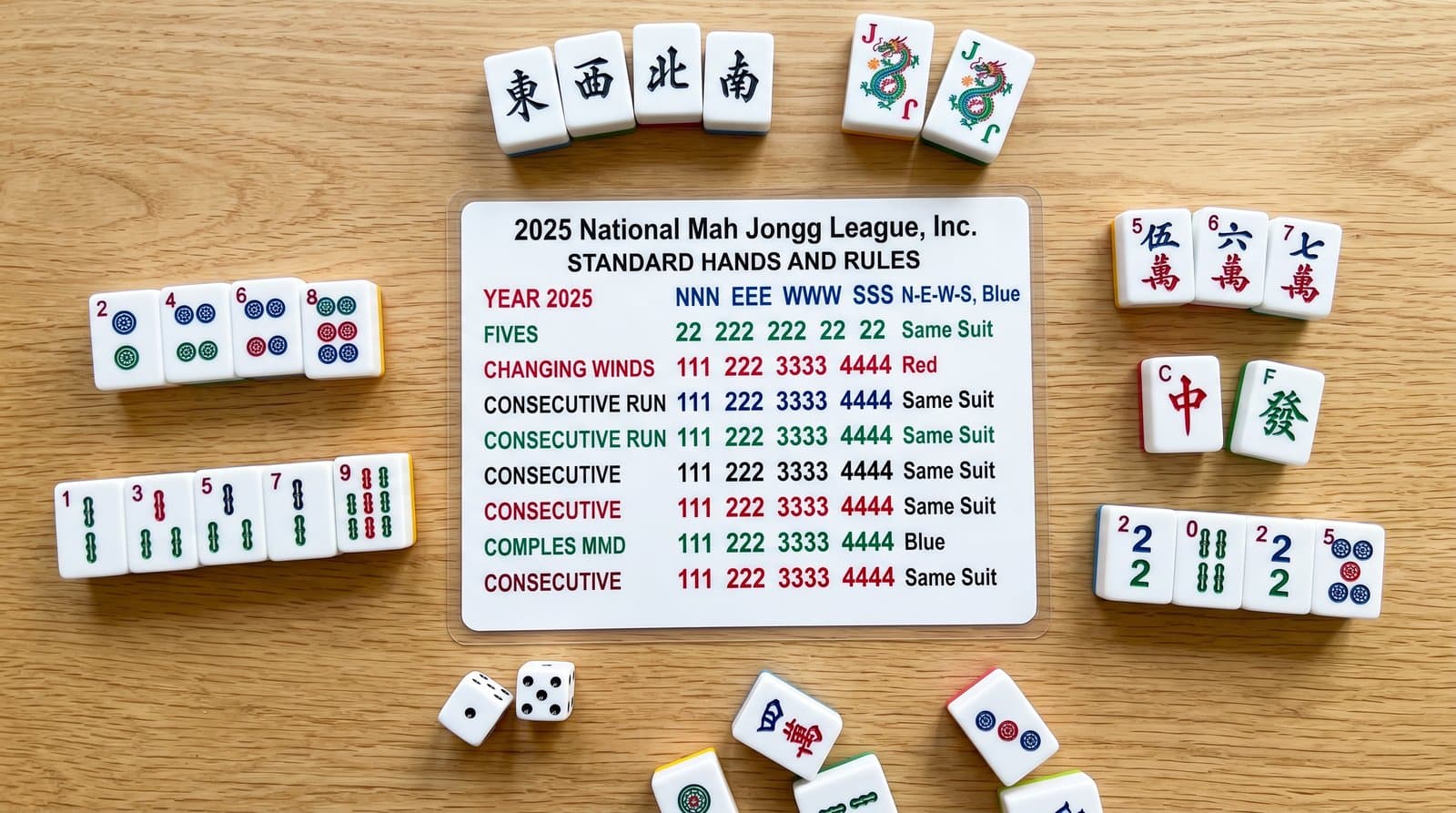
TL;DR: The NMJL card is a laminated cheat sheet listing every legal winning hand for the year. Colors indicate how many suits a hand requires, not which suits. C means concealed, X means exposed. The card has nine sections, each built around a structural pattern. If you run a club, teach the color system and section logic before you teach individual hands, and keep beginners in the "safe zone" sections (2468, Consecutive Run, 13579, 369) for their first several sessions.
Every April, you hand your students a laminated card the size of a bookmark and watch the panic set in. Thirty students, thirty identical deer-in-headlights expressions, thirty versions of the same question: "Where do I even start?"
The NMJL card is the single most important tool in American Mahjong. It lists every legal winning hand for the current year, organized by section, color-coded by suit count, and annotated with point values. If a player's tiles do not match one of these hands exactly, they cannot declare Mah Jongg. That is the entire game in one sentence.
But here is the problem nobody talks about: the card was designed for players at the table, not for instructors standing in front of a room. When you are teaching 15 or 30 people at once, you need a framework that turns a wall of tiny colored text into something your students can actually internalize. That is what this post is about.
What the NMJL Card Actually Is
The National Mah Jongg League has published a new card every year since the 1930s. Each card contains roughly 50 to 70 distinct hands, but because many hands can be played in multiple suit combinations, the actual number of winning possibilities is far higher. The 2025 card, for example, displayed 71 hands that expanded to over 1,000 unique winning combinations.
The card is roughly bookmark-sized, printed on both sides, and laminated so it survives coffee spills and purse storage. One side lists the hands. The other side shows reference information: matching dragons, basic terminology, and the Joker rules.
For your students, the card is their legal map. For you as an instructor, it is also your curriculum outline. Every section on the card becomes a potential lesson module. Once you see the card that way, teaching it gets dramatically simpler.
The Color System (It Is Not What Most Beginners Think)
This is where first-time confusion starts, and where you can save your students twenty minutes of frustration with one clear explanation.
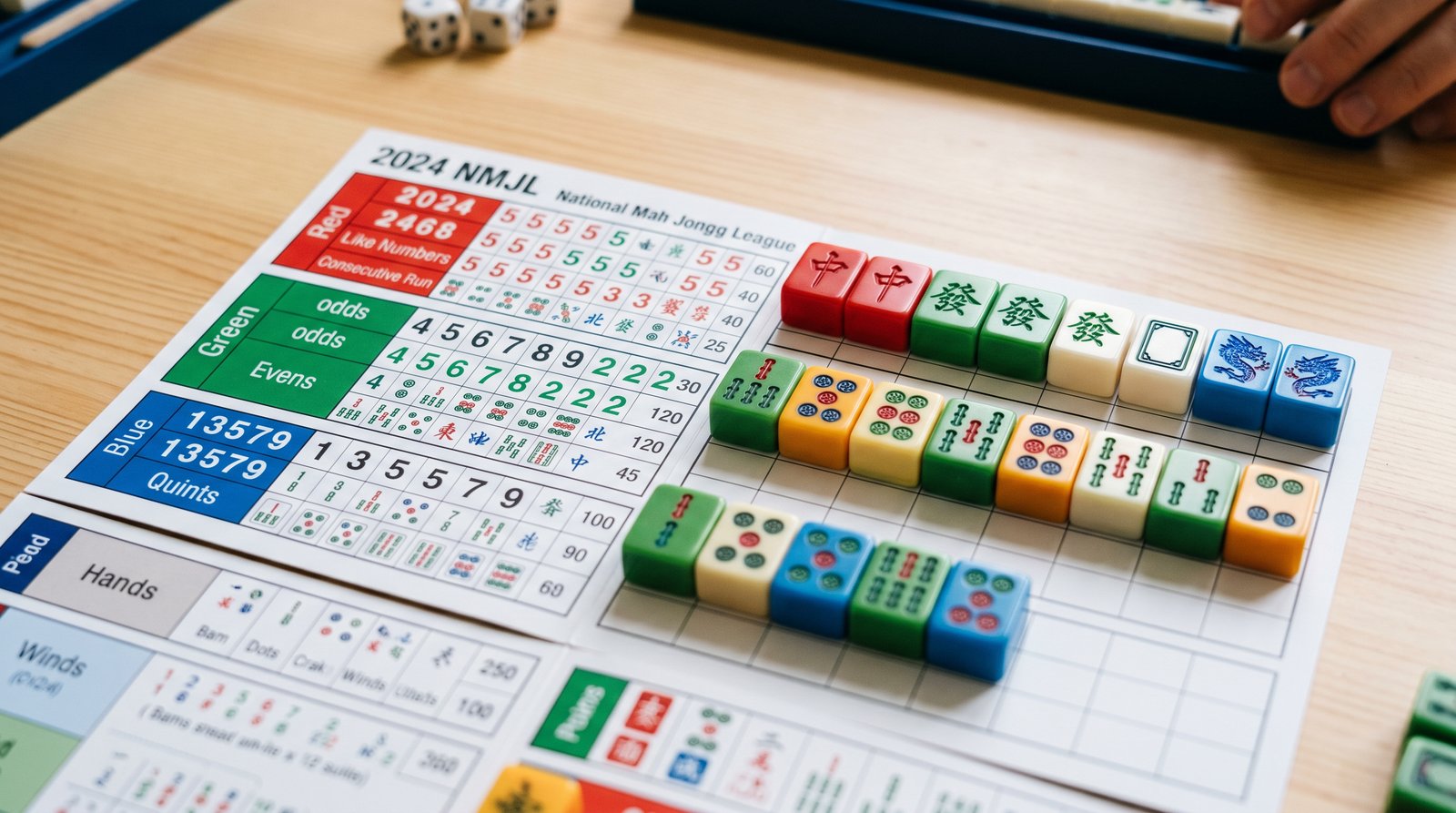
The three colors on the card (blue, green, and red) indicate how many suits a hand requires. They do not tell you which suits to use.
Here is the breakdown:
All one color means the entire hand uses a single suit. Your students pick whichever suit they want: Bams, Craks, or Dots. It does not matter which one.
Two colors means the hand requires exactly two different suits. Again, the player chooses which two.
Three colors means all three suits appear in the hand.
Certain tiles sit outside the suit system entirely. Winds (North, South, East, West), Flowers, and Soap (the white dragon, sometimes used as zero) are always printed in blue regardless of what colors surround them. They belong to no suit.
The teaching tip that saves the most classroom time: demonstrate this with actual tiles. Hold up a hand from the card that shows two colors. Build it once with Bams and Dots. Then rebuild the same hand with Craks and Bams. When students see the same hand built two different ways, the "colors equal suit count, not suit identity" concept clicks immediately.
C vs. X: Concealed and Exposed Hands
To the right of every hand on the card, you will find a letter and a number. The letter is either C or X. The number is the hand's point value.
X = Exposed. The player can call discarded tiles from other players to build groups (pungs, kongs, quints) on the table in front of their rack. This is the more forgiving category because players have more ways to complete a hand.
C = Concealed. The player must draw every tile from the wall. No calling discards, no exposing groups. The only exception: a player may call the very last tile needed to declare Mah Jongg. Concealed hands also allow joker exchanges on your turn, which is a nuance worth teaching after students understand the basics.
Concealed hands are harder to complete, which is why they carry higher point values. If a hand is worth 25 points exposed but a similar pattern is worth 35 points concealed, the difficulty gap is the reason.
For your classroom: steer beginners toward X hands for their first several sessions. Calling tiles and making exposures teaches the rhythm of the game much faster than sitting silently and hoping the wall delivers. Once students have a few games under their belts, introduce concealed hands as the "next level."
The Nine Sections and Their Structural Logic
The card is not a random list. It is organized into sections, each built around a structural theme. While specific hands change every year, the section categories stay remarkably consistent. Understanding this structure is the single biggest shortcut to reading any new card.
Here are the nine sections you will typically find:
Year Hands (e.g., 2026). These incorporate the digits of the current year. They tend to be creative and thematic, and because many hands in this section share overlapping tiles, students can pivot between hands without fully committing early.
2-4-6-8 (Evens). Built entirely from even-numbered tiles. This section is often one of the richest on the card, with multiple hand structures, single-suit and multi-suit options, and strong joker eligibility. A reliable starting zone for beginners.
Any Like Numbers. Hands where one number repeats in different groupings. Often beginner-friendly because the "any number" flexibility reduces how precisely a student needs to build.
Quints. Hands requiring five of the same tile. Since each tile only has four copies in the set, at least one Joker is mandatory. Quints are exciting but advanced; save them for later in your curriculum.
Consecutive Run. Sequential numbers (like 1-2-3 or 5-6-7) across one or more suits. Another section with broad flexibility and good pivot potential.
1-3-5-7-9 (Odds). Odd-numbered tiles only. Structurally interconnected, which means students who pick up one hand in this section often find themselves close to another.
3-6-9. A smaller section that rewards patience. A key detail to share with your students: 6 appears in every single hand in this section. If a student is holding multiple 6s, point them here.
Winds and Dragons. Honor tiles: the four Winds and the three Dragons. These hands often have distinctive structures that stand apart from the number-based sections.
Singles and Pairs. Hands made entirely of individual tiles and pairs. Nearly all of these are concealed (C) hands, making them the most advanced section on the card. Introduce this section last.
When you teach section logic before individual hands, you give students a mental filing system. Instead of staring at 70 hands and feeling lost, they see nine categories and think, "I have a lot of even numbers, so let me check the 2468 section." That is the breakthrough moment.
The Operator Angle: How to Teach the Card Without Losing Your Group
If you are running a mahjong club or teaching lessons, you already know that the NMJL card is the single hardest thing to teach. Tom Sloper, one of the most cited American Mahjong authorities, puts it bluntly: the card is "the most difficult thing to teach (and the most difficult thing for an NMJL player to learn)."
The good news is that experienced instructors have converged on a scaffolding approach that works. Here is the sequence.
Do Not Start With the Card
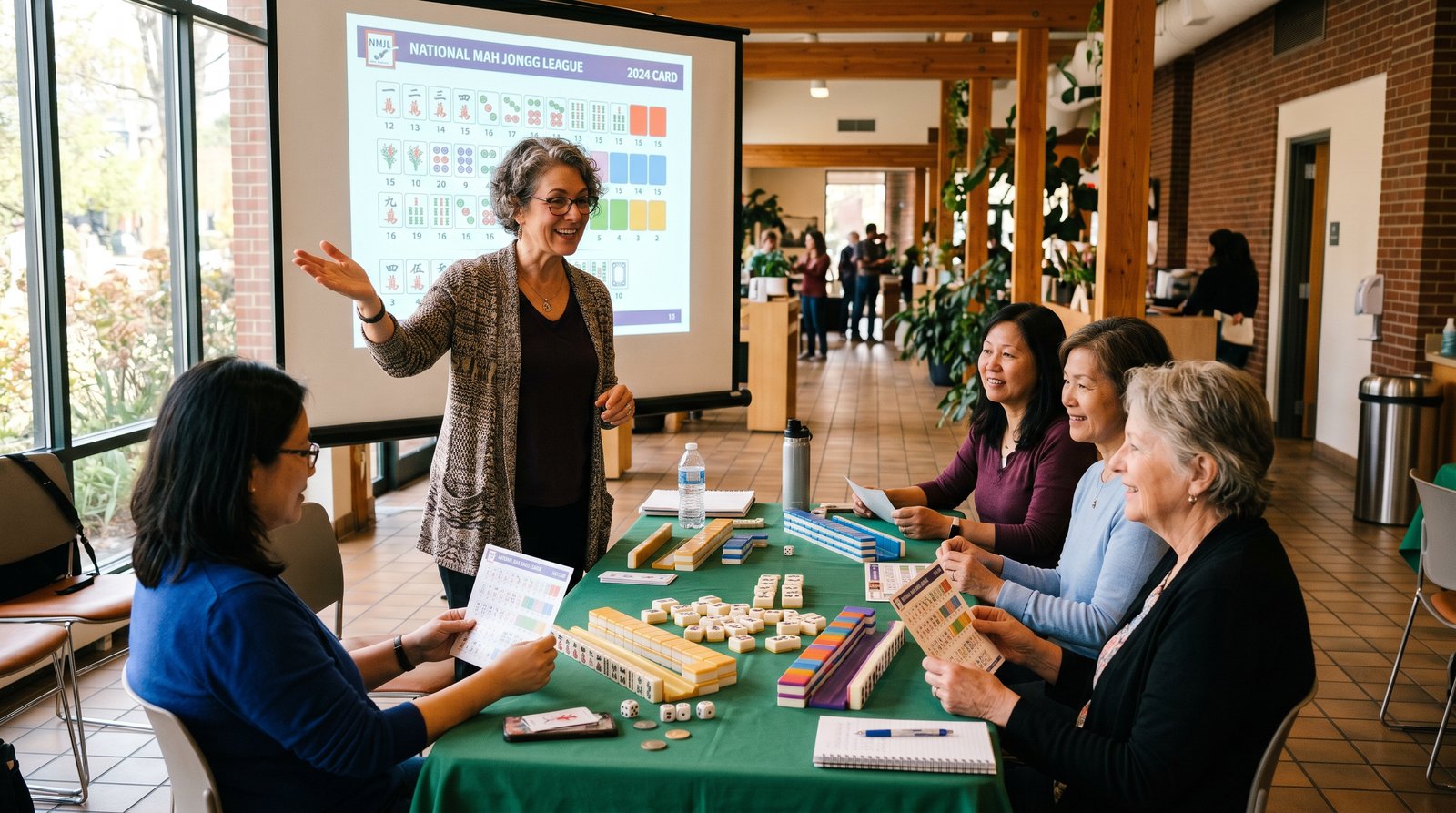
This sounds counterintuitive, but the research from Mahj Life, Sloperama, and multiple club curricula all agree: beginners should not see the NMJL card until they have already learned tiles, basic terminology (singles, pairs, pungs, kongs), and the flow of a turn. If you are building a lesson plan for your first class, tile recognition and open-hand practice should come first.
Tom Sloper delays the card until the third lesson. In the first two sessions, his students play simplified hands (four pungs and a pair, or three kongs and a pair) with tiles fully exposed. They learn the rhythm of picking, discarding, and calling before they ever worry about matching a specific hand on the card.
Teach the System, Not the Hands
When you do introduce the card, resist the urge to walk through it hand by hand. Start with the three concepts that unlock everything:
- The color system (suit count, not suit identity)
- C vs. X (concealed vs. exposed)
- Section categories (the nine structural themes)
Once students grasp these three ideas, the card transforms from a confusing wall of text into a reference guide they can navigate on their own.
Define a "Safe Zone" for Beginners
Not all sections are created equal. For students in their first several sessions, focus on four sections:
- 2468 (exposed hands, joker-eligible, multiple suit options)
- Consecutive Run (flexible, strong pivot potential)
- 1-3-5-7-9 (clear patterns, interconnected hands)
- 369 (small section, easy to memorize)
These four sections give beginners enough variety to stay engaged without overwhelming them. Save Year Hands (which change every year and can be tricky), Quints (which require advanced joker strategy), Winds and Dragons (unusual structures), and Singles and Pairs (concealed, advanced) for later.
Use Open-Hand Play for Card Learning
Have students play with their tiles visible on top of the rack. This lets you coach in real time: "You have three 4s and two 6s. Look at the 2468 section. Do you see a hand that could work?" That guided discovery is worth more than any lecture.
Sloper emphasizes keeping everyone at one table during card introduction so the whole group learns from each question and answer. If your club is larger, consider splitting into coached tables of four with an experienced player at each one.
Build Section Fluency Over Sessions
Do not try to cover the entire card in one session. A practical teaching calendar might look like this:
- Session 1-2: Tile recognition, terminology, open-hand play with simplified hands (no card)
- Session 3: Introduce the card. Teach colors, C/X, and section structure. Play open-hand using only the 2468 section.
- Session 4: Add Consecutive Run and 13579. Students choose from three sections.
- Session 5: Add 369 and Any Like Numbers. Introduce the concept of pivoting between sections.
- Session 6+: Open the full card. Introduce concealed hands and more advanced sections.
If you are looking for more detail on structuring your lessons and pricing them sustainably, that sequence gives you a natural six-session arc that students can follow at their own pace.
Managing the Annual April Card Transition
Every spring, the NMJL releases a new card and the entire American Mahjong community resets. For players, this is exciting. For instructors and club operators, it is a logistical event that requires planning.
Here is what experienced operators do:
Pre-order cards for your group. Many clubs place a bulk order in February to ensure cards arrive in April. This saves your students the hassle of ordering individually and gives you a small coordination win that builds community.
Host a card-study session before your first game on the new card. Gather your group, project the card (or pass out copies), and walk through the changes together. Compare it to last year's card. Which sections grew? Which shrank? Are there new structural patterns? This collective review session is one of the best retention events you can run all year.
Give your students a transition window. The duration of adjustment depends on how often your group plays. Weekly groups typically feel comfortable within three to four weeks. Monthly groups may need two to three months. Be patient, and remind your students that veterans and beginners are on equal footing during April because everyone is learning the same new card at the same time.
Use the transition as a recruiting moment. April is the one time of year when experienced players cannot lean on memorization. If you are thinking about turning card-drop season into a growth opportunity, this annual reset is your best opening. New members feel less intimidated joining a group where everyone is still figuring out the new hands.
Frequently Asked Questions
Do the colors on the NMJL card tell me which suits to use? No. The colors (blue, green, red) indicate how many suits a hand requires, not which specific suits. All one color means one suit of your choice. Two colors means two suits. Three colors means all three. Winds, Flowers, and Soap are always shown in blue and belong to no suit.
Can I use Jokers in any hand? Jokers can substitute for any tile in a group of three or more (pungs, kongs, quints). They cannot replace singles or pairs. This means hands in the Singles and Pairs section, and any portion of a hand that calls for individual tiles or pairs, are joker-free zones.
What happens if I am mid-lesson when the new card comes out in April? Finish your current lesson series on the old card, then schedule a dedicated transition session. Trying to switch cards mid-curriculum creates confusion. Most instructors complete their current cycle, host a card-study session, and then begin fresh with the new card.
Should beginners memorize the entire card? Not at first. Start with the section structure and two or three sections that match your students' skill level. Memorization comes naturally through repetition over weeks of play. Pushing for full-card memorization too early leads to frustration and dropouts.
Get Your Students Reading the Card With Confidence
Teaching the NMJL card is the hardest part of running a mahjong program, but it does not have to be the part where you lose people. When you teach the system (colors, notation, sections) before the specifics, scaffold your curriculum from simple to complex, and give beginners a safe zone to build confidence, card literacy stops being a barrier and starts being the thing that hooks them.
If you are building a mahjong club or scaling an existing teaching practice, and you want a tool that helps your students track hands, manage card transitions, and stay engaged between sessions, Mahjician was built for operators like you. You can book a demo to see how it fits into your workflow.