What Are Jokers in Mahjong? Rules Every Player Needs
Jokers are eight wild tiles found only in American mahjong. Learn exactly when you can use them, when you cannot, how the joker exchange works, and how to leverage them strategically.
By Trey Peirce
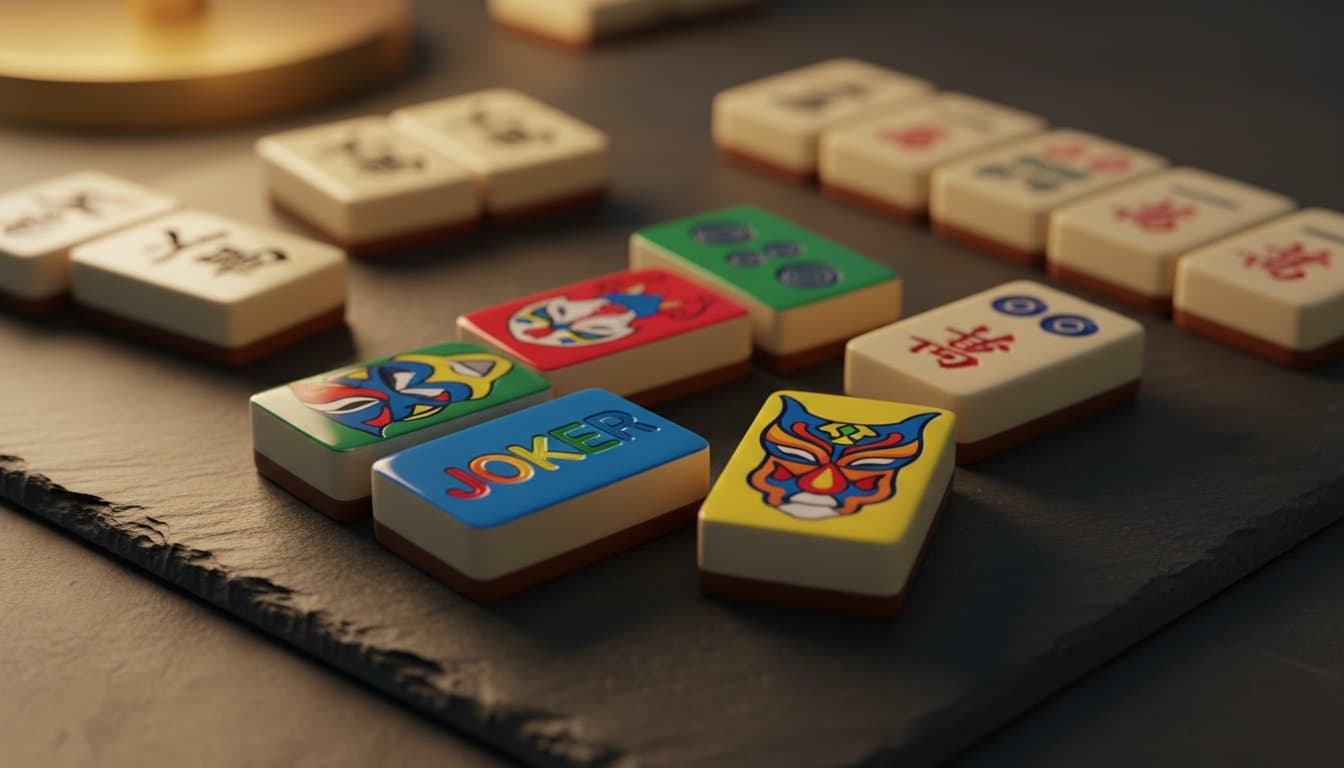
TL;DR: Jokers are eight wild tiles found only in American mahjong. They can substitute for any tile in a pung (three of a kind), kong (four of a kind), or quint (five of a kind), but they cannot be used in singles or pairs. Discarded jokers are dead and cannot be claimed by any player. If an opponent has an exposed meld that contains a joker, you can swap in the natural tile on your turn and take the joker for yourself.
What Are Jokers in Mahjong?
Jokers in mahjong are eight wild tiles included in every American mahjong set. Each joker can stand in for any other tile when building a pung, kong, quint, or sextet. They exist only in the American game as played under National Mah Jongg League (NMJL) rules; you will not find them in Chinese, Japanese Riichi, or Hong Kong mahjong. A standard American set contains 152 tiles total: 144 suit, wind, dragon, and flower tiles, plus those 8 jokers.
Because jokers are wild, they dramatically expand your options when chasing a hand. A joker you pick off the wall can complete a three-of-a-kind you were short one tile for, or fill out a kong when the fourth natural tile has already been discarded. That power is balanced by hard restrictions: jokers cannot go anywhere near a pair, a single, or any sequence (chow), and a joker you discard is gone forever.
How Many Jokers Are in a Mahjong Set?
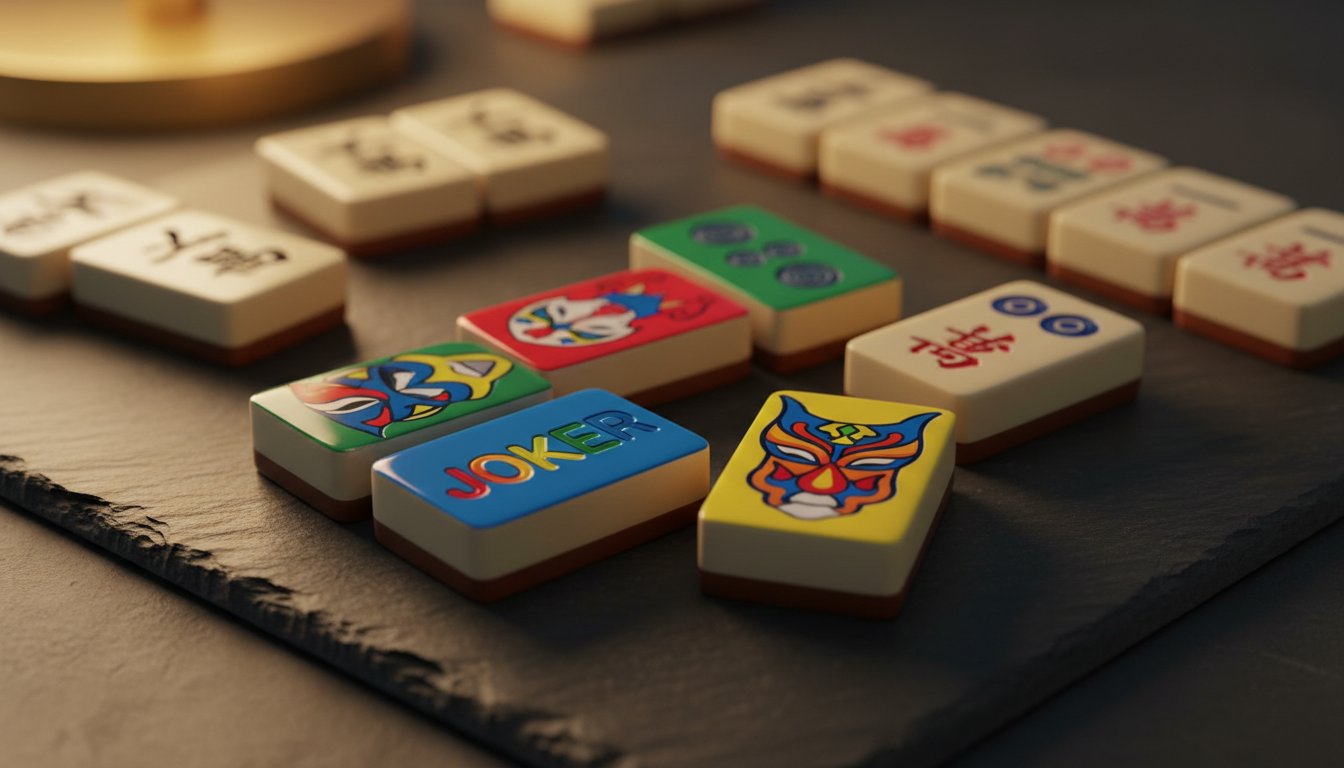
Every NMJL-compliant American mahjong set includes exactly eight joker tiles: four printed with one design and four with another (often a jester face or the word "Joker" in stylized text). They are identical in function; the two designs exist purely for visual variety and to help players visually distinguish tiles at a glance during fast-paced play.
When shopping for a set, the joker count is one of the most reliable ways to confirm you are buying an American mahjong set rather than a Chinese or Japanese one. Chinese Mahjong (including Hong Kong and Cantonese variants) and Japanese Riichi sets contain 136 tiles, sometimes 144 with flowers, and no jokers at all. If the box says 152 tiles and shows jokers, you have an American set. If you have a friend who returned from a trip to Asia with a beautiful traditional mahjong set, check the tile count before your next game night: it almost certainly will not work for NMJL-style play without a swap.
One firm rule during the Charleston: jokers cannot be passed. You keep them in your hand through the entire pre-game exchange. That restriction applies to both the mandatory first Charleston and the optional second Charleston, as well as the courtesy pass. If you are sitting on three or four jokers in your opening hand, consider yourself lucky; they are staying with you. New players sometimes assume jokers can be passed because they are "extra" or unusual tiles; this is a common misunderstanding that a single clear rules explanation will fix.
If you are unfamiliar with the Charleston and how it works before every hand, it is worth understanding before diving deeper into joker strategy. The full guide to the Charleston in mahjong explains the passing sequence step by step.
When You Can (and Cannot) Use Jokers
This is where new players most often trip up. The rule is simpler than it sounds once you internalize the logic: jokers are useful in multiples, useless alone.
Jokers CAN substitute in:
- Pung (three identical tiles): A joker can be the first, second, or third tile in the group.
- Kong (four identical tiles): One or more jokers can fill any position in the four-tile group.
- Quint (five identical tiles): Common on many NMJL card hands; jokers frequently appear here.
- Sextet (six identical tiles, which appears on some NMJL cards): Rare, but the same rule applies.
Jokers CANNOT be used in:
- Pairs (two identical tiles): Including the pair required in many NMJL hands. Both tiles in a pair must be natural.
- Singles (individual tiles, such as in a Singles and Pairs hand): Every tile in a Singles and Pairs hand must be a natural tile. Jokers are completely excluded from this entire hand category.
- Any sequence or run: American mahjong under NMJL rules does not use chows (sequences of consecutive numbered tiles) at all. This makes the restriction somewhat academic, but the underlying principle stands: jokers require identical tiles in groups of three or more, not sequential tiles.
There is no limit on how many jokers can appear in a single meld. A kong could theoretically be four jokers standing in for four of the same tile, though this is unusual in practice. More commonly, you see one or two jokers mixed with two or three natural tiles in a kong.
The practical consequence: if you are building toward a Singles and Pairs hand, jokers are a liability. They cannot contribute to any part of that hand category, so you should pass them off in the Charleston when possible. Holding a joker while pursuing Singles and Pairs is a dead tile taking up space in your rack.
Discards are dead. When a player discards a joker, no one can claim it. It goes face-up in the discard area, is visible to all players, but is completely unclaimable. Experienced players watch the discard pile partly to count how many jokers have been "killed" this way, which tells you how many remain in live play. A game in which three jokers hit the discard pile early feels very different from one where all eight are still in circulation.
The Joker Exchange Rule
The joker exchange is one of the most tactically interesting mechanics in American mahjong. Here is how it works:
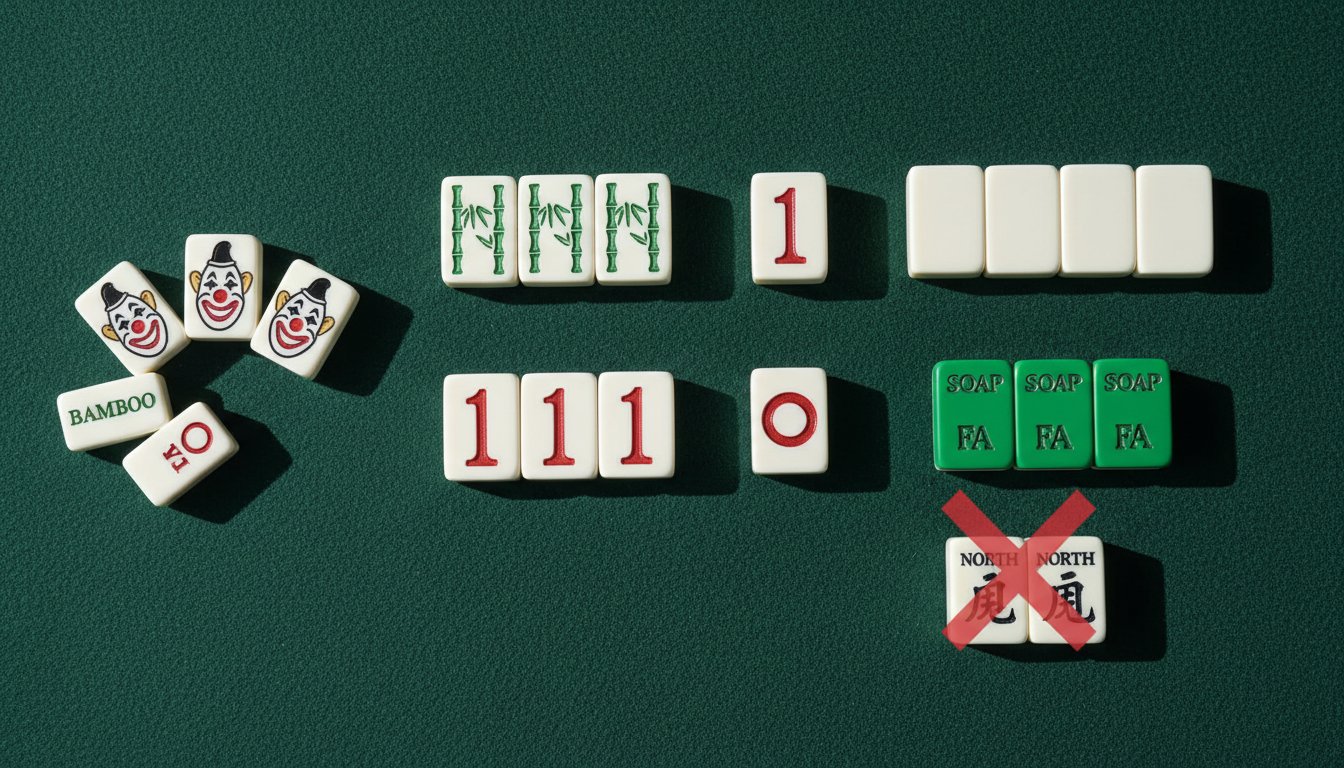
When it is your turn to draw from the wall, before you draw, you may swap a natural tile from your hand into any exposed meld on the table that contains a joker, taking that joker for yourself. The exposed meld must still be a valid meld after the exchange: you are replacing the joker with the exact natural tile the joker was standing in for.
Example: An opponent has called and exposed three 5-Bamboos, but one of those tiles is actually a joker. You have a 5-Bamboo in your hand. On your turn, you place your 5-Bamboo into their meld and take their joker. The meld remains valid (three natural 5-Bamboos). You now have a joker to deploy elsewhere.
Key constraints on the exchange:
- You can only exchange into an exposed (publicly displayed) meld, never into a concealed hand.
- You must use the exact natural tile the joker represents, not just any tile.
- The exchange happens at the start of your turn, before your wall draw.
- You may exchange multiple jokers on the same turn if you have the natural tiles to do so.
- You cannot exchange a joker for another joker.
This rule creates a fascinating secondary game within the game. Exposed melds become communal resources of sorts; players building toward joker-heavy hands sometimes place exposures strategically, knowing those jokers might be taken. Knowing when to expose a meld versus holding tiles concealed is a decision the joker exchange rule makes genuinely complex.
A Brief History of Jokers in American Mahjong
Jokers were not always part of American mahjong. When Joseph Babcock popularized the game in the United States in the early 1920s, the standard set contained eight flowers and zero jokers. The game arrived from China, and the original tile set reflected Chinese conventions. Babcock's rules were close enough to the source material that they would be recognizable to a Chinese player today, just with English-language notations added for accessibility.
The National Mah Jongg League was founded in 1937 by a group of women in New York City who wanted to standardize American play and publish a unified scoring card. In the early NMJL era, flowers served a loosely "wild" function in certain contexts, but true joker tiles were not yet standard equipment. The 1937 game had more in common with classical Chinese mahjong than the version played today in American living rooms and community centers.
The shift came in 1960 and 1961. According to mahjong historian Tom Sloper, the NMJL began formally requiring joker tiles in sets starting around 1960-61, coinciding with card designs that presupposed their use. Some American-made sets from the mid-1940s included two joker tiles as an early experiment, with MET Games and Ten Flowers sets being among the notable examples. But eight became the standard only with full NMJL adoption around 1961. The 1961 date is widely cited as the moment jokers became an official, codified element of American mahjong.
It is worth noting that the name "joker" almost certainly borrowed from the playing card tradition: jokers in a standard deck of cards are wild cards, and the same logic applied when the tile was introduced. The visual design of mahjong joker tiles (jester faces, stylized fonts, colorful borders) echoes that playing-card heritage.
Since then, jokers have been inseparable from the American game. They are one of the primary reasons American mahjong feels so different from its Chinese and Japanese cousins, and why a player who shows up to an American game having only played Japanese Riichi may be briefly disoriented. The comparison table below illustrates just how distinct the approaches are across major variants.
Joker Comparison Across Mahjong Variants
| Feature | American (NMJL) | Chinese Classical | Hong Kong | Japanese Riichi |
|---|---|---|---|---|
| Joker tiles in set | 8 | 0 | 0 | 0 |
| Wild tile mechanic | Yes, jokers wild in pungs/kongs/quints | No | No | Red fives (bonus, not wild) |
| Can be used in pairs | No | N/A | N/A | N/A |
| Can be discarded | Yes (dead on discard) | N/A | N/A | N/A |
| Exchange rule | Yes | No | No | No |
| Sequences allowed | No | Yes | Yes | Yes |
| Governing body card | NMJL annual card | Various rule books | House rules | Japan Mahjong Rules |
For a deeper look at how American mahjong differs from other styles, see our full breakdown in American Mahjong vs. Japanese Mahjong.
Joker Strategy: When to Hold, When to Play
Jokers are not automatically worth keeping. Situational awareness governs when they pay off. A player who treats every joker as a precious gift and hordes them through the entire game will sometimes miss faster paths to winning. Flexibility is the key word.
Hold jokers when:
- You are building a kong or quint and are short one or two natural tiles. A joker steps in while you wait for the natural tile to appear or be exchangeable.
- You are late in the game and need to complete your hand quickly. Jokers speed up completion when tile availability tightens and discards become more dangerous to call.
- You are building a high-value hand that requires a kong or quint in a scarce tile (like a specific wind or a particular dragon). The natural tiles may simply not be reachable in a live game; a joker fills the gap definitively.
- You are early in the game and have not yet committed to a hand. Jokers keep options open across multiple potential hand paths.
Release jokers (via Charleston) when:
- You are pursuing a Singles and Pairs hand, where jokers contribute nothing. Pass them and pick up tiles that advance that hand.
- Your opening tiles show no clear three-of-a-kind or better in any suit. Holding jokers in a weak opening hand delays your flexibility without a clear payoff.
- You have more jokers than your target hand requires. If your target hand has one kong and you are already holding two jokers, passing the third joker (if you have one) is reasonable.
- You are in a game where you suspect opponents are chasing joker-heavy hands. Passing them a joker that helps their hand more than yours is a deliberate strategic choice, not just a mistake.
Thinking about exposure: Once you expose a meld containing a joker, any opponent can claim that joker on their turn by placing the natural tile. If jokers are scarce in a particular game (several already discarded), exposed jokers become high-value targets. Sometimes it is worth delaying an exposure specifically to protect a joker from exchange, particularly if you need it to complete your hand and natural replacements are unlikely to be in your opponents' hands.
Counting dead jokers: Pay attention to how many jokers have been discarded throughout the game. In a live game with eight jokers, each dead joker tightens the supply for everyone. If four jokers are already in the discard pile, the remaining four are extremely valuable and opponents are likely competing hard for them. Conversely, if you are deep into a game and no jokers have been discarded, expect that your opponents are sitting on them and plan accordingly.
Jokers and defensive play: When you are not close to winning and need to play defensively (avoiding discards that might complete an opponent's hand), a joker in hand is not discardable as a defensive move. It either stays with you or goes into a meld. That constraint matters when you are trying to avoid feeding an opponent's hand in the endgame.
The NMJL card changes every year, and some card editions feature more joker-dependent hand categories than others. Learning the new NMJL card with an eye toward which hands lean on kongs and quints (and therefore jokers) gives you a strategic edge at the table from day one of the new card year.
Why Jokers Matter for Club Operators
If you run or are considering running an American mahjong club, jokers are a recurring source of rules questions, especially from newer players.
The joker exchange rule trips up beginners most often. New players regularly forget that the exchange happens before the wall draw, not after. They also commonly attempt to exchange into concealed hands, which is illegal. Having a clear, posted house rules sheet that covers joker exchange step-by-step prevents arguments and keeps games moving.
Jokers also affect your teaching sequence. When you introduce the game to a brand-new group, the Charleston is complex enough on its own (and jokers cannot be passed in it, which is itself a rule new players need). Many experienced instructors teach jokers as a "week two" concept: get players comfortable with reading the card, the Charleston, and basic turn structure first, then layer in joker exchange once the fundamentals are solid. Our guide to teaching the new NMJL card without losing your group covers pacing your instruction across sessions.
For clubs that run tournaments or track scores, joker-related disputes are among the most common rulings a director will face. Standardizing your table rules around NMJL guidelines from the start saves headaches later. If you are just getting your club off the ground, the guide to starting a mahjong club walks through the organizational steps, including how to set consistent house rules your members can rely on.
Mahjician gives club operators the tools to manage rosters, communicate rule updates to members, and organize sessions with less friction. When a rules question about jokers comes up, your members can reference the same source instead of debating from memory. See how Mahjician supports club operators.
FAQ
Can jokers be used in a pair?
No. Jokers cannot be used in any two-tile composition. Pairs must consist of two identical natural tiles. This is one of the most important joker restrictions in American mahjong and applies to every single hand on the NMJL card, including hands in the Singles and Pairs category, where jokers are entirely useless.
What happens when you discard a joker?
A discarded joker is dead. No player may claim it, call it, or use it in any way. It sits face-up in the discard pile for the rest of the game. This is why experienced players almost never discard a joker unless they have no choice: once it leaves your hand as a discard, it is gone from live play permanently.
Can you exchange a joker on any turn?
You may attempt the joker exchange on any of your turns, but only at the very start of your turn before you draw from the wall. You need the exact natural tile that the joker represents in that exposed meld. If you do not have that tile, you cannot make the exchange. You may make multiple exchanges in a single turn if you have the required tiles.
Are jokers used in the Charleston?
No. Jokers cannot be passed during the Charleston. This applies to both the mandatory first Charleston and the optional second Charleston. If you start a hand with three or four jokers, you keep all of them through the entire pre-game exchange. This is frequently tested in NMJL rules quizzes and is a reliable way to identify whether someone learned the rules correctly.
Do all mahjong variants use jokers?
No. Jokers are specific to American mahjong as codified by the NMJL. Chinese Classical, Hong Kong (Cantonese), and Japanese Riichi mahjong do not use joker tiles. Some regional variants like Thai and Vietnamese mahjong include wild tiles with different mechanics. If you are learning a non-American style, joker rules from this article do not transfer. See our comparison of American mahjong vs. Japanese mahjong for a full side-by-side breakdown.
Ready to build a club around the game? Start with how to start a mahjong club and learn about the Charleston, the pre-game ritual that sets up every hand.