Who Plays American Mahjong? A Portrait of Today's Player
The American Mahjong player base is growing fast, and the next wave looks different from your current regulars. Here is what the data says, and what it means for your club.
By Trey Peirce
TL;DR. The American Mahjong player base is estimated at 600,000 to 750,000 and growing fast. The core demographic is women over 55, but Gen Z and millennial players are entering at record pace. Eventbrite mahjong listings rose 179% from 2023 to 2024, and Yelp searches for mahjong clubs surged nearly 4,500% year over year. For operators, this means your next wave of players looks different from your current regulars.
If you run a mahjong club, studio, or teaching program, you probably have a mental picture of your typical player. She is in her sixties, retired or semi-retired, plays NMJL rules, and heard about your group through a friend at synagogue or the country club. That picture is not wrong. But it is incomplete, and it is changing faster than most operators realize.
Understanding who actually plays American Mahjong is not an academic exercise. It is operational intelligence. The demographics of your player base shape your pricing, your scheduling, your marketing channels, and the way you onboard new members. Get the portrait wrong, and you build a club for an audience that is slowly shrinking while a new one knocks on the door.
The Numbers: How Big Is the Player Base?
There is no census of American Mahjong players. The National Mah Jongg League does not publish its membership figures publicly, and no government agency tracks tile-game participation the way the Census Bureau counts pickleball courts.
The best available estimate comes from Tom Sloper, a longtime mahjong expert who maintains one of the oldest mahjong resources on the web. His FAQ on demographics puts the total American Mahjong player base somewhere between 600,000 and 750,000 people, anchored by the roughly 300,000 NMJL members who purchase the official card each year. Sloper is careful to note that "there is no hard data" and that these are estimates, not verified counts.
Even at the conservative end, 600,000 players makes American Mahjong one of the larger organized social-game communities in the country. For context, the American Contract Bridge League has about 160,000 members. Mahjong is roughly four times that size, with far less institutional infrastructure supporting it.
The Core: Women Over 55
The heart of American Mahjong remains what it has been for decades: women over 55, predominantly Jewish, concentrated in the Northeast, Florida, and Southern California. Sloper's demographic research estimates that males represent under 5% of the American Mahjong player base.
This is the demographic that built the game's modern culture. They are the players who buy the NMJL card every April, who organize weekly games in their living rooms, and who form the backbone of the clubs and studios that operators like you depend on.
If Sandra (our shorthand for the typical NMJL instructor running 3-8 weekly sessions) looked at her roster right now, she would see this core reflected back: mostly retired women, mostly comfortable with the NMJL ruleset, mostly recruited through word of mouth and existing social networks.
But the edges of that roster are already starting to blur.
The Surge: Younger Players Are Coming
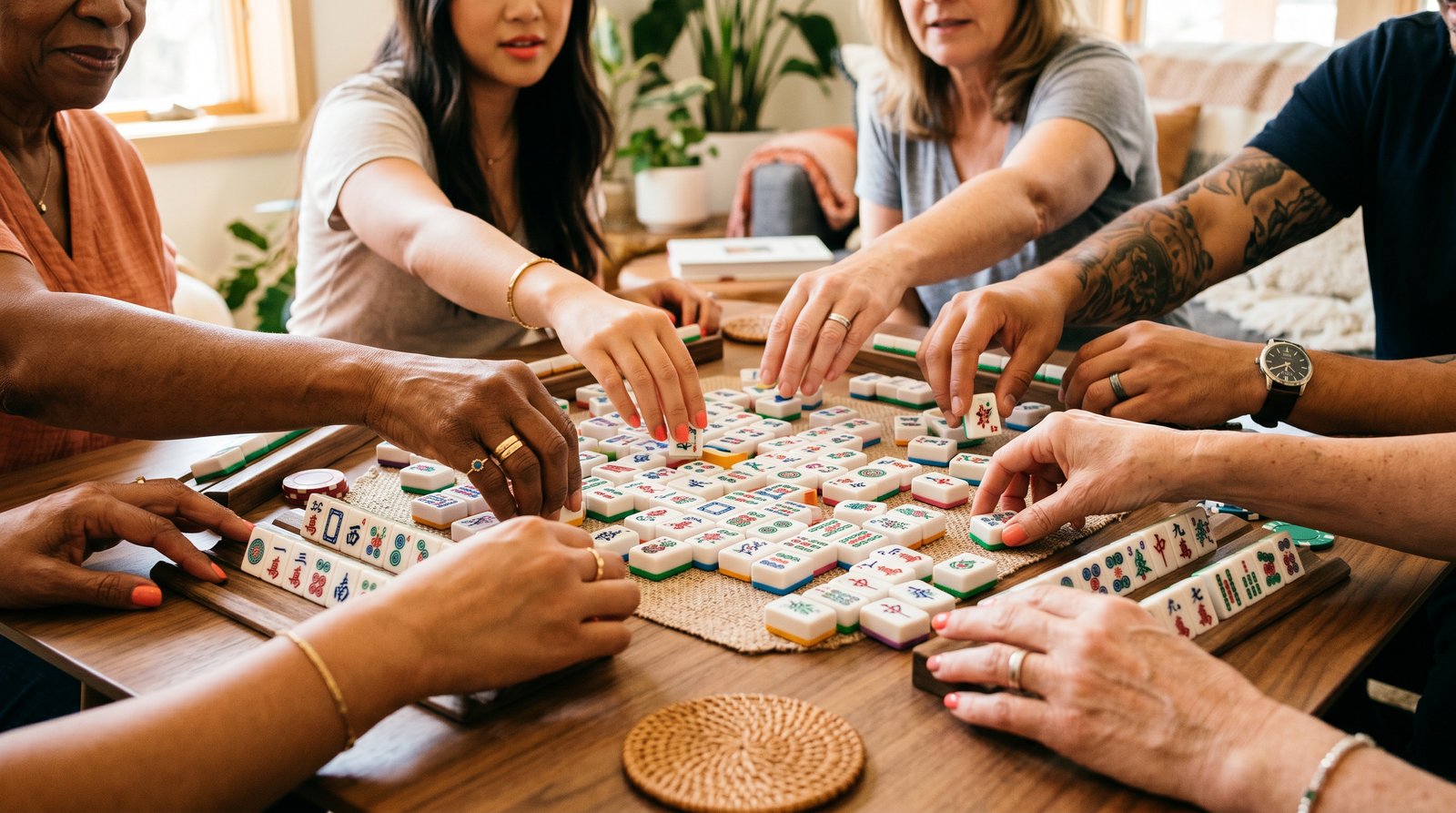
The data on mahjong's growth among younger demographics is hard to miss. In April 2026, WBUR reported that Yelp searches for mahjong clubs surged nearly 4,500% year over year, citing a wave of interest driven by social media and a new generation discovering the game. Earlier reporting from NPR in January 2026 covered the same trend, profiling young players in their twenties and thirties who came to mahjong through TikTok and Instagram rather than family tradition.
The numbers from event platforms tell the same story. NBC Bay Area reported in September 2025 that Eventbrite mahjong event listings rose 179% from 2023 to 2024. A separate analysis found that mahjong events on the platform increased 45-fold between 2021 and 2025.
The Smithsonian featured mahjong's resurgence in February 2025, placing it alongside pickleball and birdwatching as activities experiencing a post-pandemic boom driven by younger participants seeking in-person social connection.
None of this means your Thursday morning group is about to be overrun by twentysomethings. The demographic center of gravity is still firmly with the over-55 crowd. But the inflow pipeline is shifting. The people Googling "mahjong club near me" today are increasingly in their thirties and forties, often with no family history of playing the game.
Why the Shift Matters for Operators
If you operate a club or studio, the demographic shift creates three specific operational questions you need to answer:
1. Are You Visible Where New Players Look?
Your current members found you through word of mouth, Facebook groups like "Mah Jongg, That's It!" (67,000 members), or community bulletin boards. Younger players search Google, check Yelp, and browse Eventbrite. If your club has no web presence beyond a Facebook group, you are invisible to the fastest-growing segment of the market.
This is also why your scheduling matters more than ever. Younger players often work full-time. They need evening and weekend sessions, not Tuesday at 10 a.m.
2. Can Your Onboarding Handle Beginners Who Are Not Your Typical Beginner?
A 35-year-old who learned mahjong basics from a YouTube video and wants to try NMJL rules has different expectations than a 65-year-old whose neighbor taught her over coffee. The younger player expects a sign-up flow, a clear session schedule, and transparent pricing. She is less likely to tolerate a group text chain as the primary communication channel and more likely to expect a booking system.
If your sub-request process still runs through a group text, the new wave of players will find it frustrating before they even sit down at a table.
3. Do You Understand What They Already Know?
Newer players increasingly arrive knowing a variant other than NMJL. Some played Japanese Mahjong (Riichi) online through Mahjong Soul. Others learned a simplified version from a mobile app. They understand the basic mechanics (draws, discards, melds) but need to learn the specifics of the NMJL card, the Charleston, and American scoring conventions.
This is good news for instructors. These are not true beginners. They already love the game. They just need a bridge into the NMJL ecosystem, and teaching the new card each year gives you a natural on-ramp.

The Cognitive Angle: Why Mahjong Attracts Health-Conscious Players
One driver of mahjong's growth among all age groups is the emerging research on cognitive benefits. A 2024 scoping review published in the Journal of Prevention of Alzheimer's Disease (available via PubMed Central) found associations between regular mahjong play and reduced dementia risk, stable cognitive function, and improved mental health outcomes.
This research matters operationally because it creates a secondary motivation for joining. Some of your newer members are not coming for the social experience alone. They are coming because their doctor, their adult children, or a health article told them that cognitively stimulating group activities help maintain mental sharpness.
Community centers and senior living facilities, in particular, are paying attention. If you run a program inside a JCC, a parks department, or an assisted living community, the cognitive-health narrative gives you a stronger pitch to your program director. It reframes mahjong from "a game some residents like" to "a structured cognitive wellness activity with peer-reviewed support."
The Cultural Conversation
Any honest portrait of the American Mahjong community also needs to acknowledge the cultural conversation happening around the game. Mahjong originated in China, and its adoption by non-Chinese Americans (particularly through the NMJL and its distinct rule set) raises questions about cultural ownership, appropriation, and respect that the community has been grappling with publicly since at least 2021.
This conversation is ongoing, and it is not one that operators can ignore. Your players are aware of it. Some feel strongly on one side or the other. As an operator, your job is not to resolve the debate but to foster a community that can hold these conversations with good faith and mutual respect.
The growth of mahjong among younger, more diverse players is actually making these conversations richer. Newer players often bring a more global perspective on the game's origins and are eager to learn about its cultural history alongside its rules.
What This Means for Your Next Twelve Months
The mahjong boom is real. The player base is growing, it is diversifying, and the growth pipeline is shifting toward digital discovery channels that many operators have not invested in.
Here is the practical takeaway: your current regulars are not going anywhere. The core NMJL community is loyal, dedicated, and the foundation of your business. But the next 50 members who walk through your door (or click through your website) will look different from the last 50. They will be younger, more digitally native, and more likely to have found you through a search engine than through a friend.
Operators who recognize this shift early will recruit from the card-drop surge, build onboarding paths for cross-variant players, and make their dues collection smooth enough that a new player can sign up and pay before she changes her mind.
The ones who don't will keep running a great Tuesday morning game. But they will miss the Tuesday evening one that someone else builds.
If managing the growing complexity of a diversifying player base sounds like your near future, book 30 minutes with us to see how Mahjician can help you stay ahead of it.